
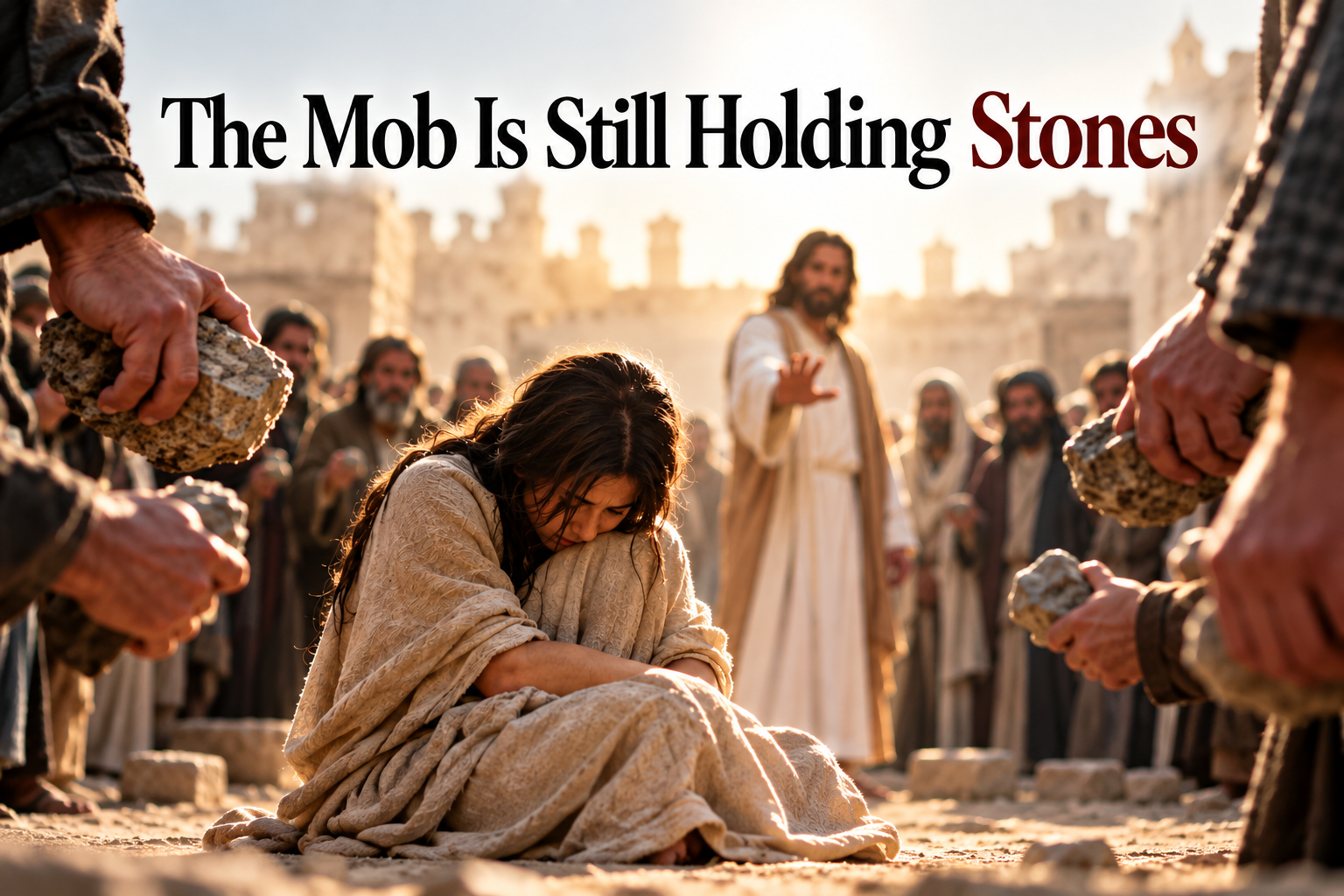
Far too often, I come across images like the one below on social media—designed for no other purpose than to provoke conflict, sow division, and ignite contentious arguments. They’re usually shared by individuals who are more interested in asserting the superiority of their “team” than in embodying the spirit of their faith. Inevitably, these posts include some mention of how those outside their group are destined to burn in “hell,” a sentiment that directly contradicts the very teachings they claim to uphold—especially the command not to judge others.
There is nothing remotely Christlike about sharing content that stirs hostility or fosters spiritual tribalism. In fact, doing so reveals a deep misunderstanding of Jesus’ message. To intentionally incite religious friction—however subtle—is not only unhelpful, it’s entirely antithetical to the purpose of spirituality itself, which is to cultivate peace, love, humility, and unity. The moment you fall into “my team is better than yours,” you’ve already lost the essence of what it means to walk in alignment with the divine.
Counter Productive Anti-Spiritual Meme Below

And in classic human irony, those who post content like this often do so not only to assert that Jesus’ teachings are superior to those of figures like the Buddha, but also while clearly demonstrating that they have little to no understanding of what the Buddha actually taught. If they did, they would recognize the profound similarities between the two—teachings that, rather than contradicting one another, often harmonize and complement each other beautifully.
They would also recognize that, much like the Buddha, Jesus never instructed or demanded worship. For Christians who point to verses stating that “whosoever believeth in him shall have eternal life” as justification for worship, it’s important to understand that due to flawed translations and centuries of misinterpretation, the phrase “believeth in him” was never meant to imply worship. Rather, it means to trust in him, to emulate his life, and to follow the guidance he offered.
There’s a stark contrast between simply saying, “I believe in him,” and actively living by the instructions he gave. One leads to the formation of a religion that centers on worship and veneration, while the other initiates a spiritual path—a way of living grounded in love, selflessness, and inner transformation, where awakening is possible and worship is unnecessary.
It’s also important to note that the modern interpretation of “I believe in him” often causes people to assume their spiritual journey is complete the moment they make that declaration. This mindset reduces faith to a passive statement rather than an active path. In contrast, the deeper and more accurate understanding involves embodying the benevolent, altruistic, and selfless principles Jesus taught—principles that, when practiced sincerely, lead to genuine spiritual awakening and transformation.
It should also be acknowledged that reducing one’s entire spiritual journey to simply saying “I believe in him” often leads people to eventually reject spirituality and religion altogether. And understandably so—if all they’ve done is recite a phrase without experiencing any real transformation, they’re left with no tangible results. When the deeper instructions are misunderstood or ignored, disappointment is inevitable. This has led many to become disillusioned atheists, assuming the whole thing is meaningless.
But the truth is, the spiritual path Jesus outlined does produce real, observable change—when followed correctly. The effects aren’t meant to be taken on blind faith; they are meant to be experienced. Inner peace, healing, and awakening are not abstract promises—they are the natural outcomes of living according to the teachings.
Many of these same individuals, having experienced no profound or transformative shift in their lives, still go on believing they’ve been “saved” simply because they once declared, “I accept Jesus.” With that declaration seen as the end of their spiritual journey, they continue living as they always have—often still harboring hatred, racism, and other harmful attitudes—convinced that their reward lies in the afterlife rather than in any meaningful change here and now. In their minds, salvation is a future promise, not a present transformation.
Going back to the point of tribalism being against everything spirituality/unity is supposed to establish. Jesus taught that we are all one, so the constant desire to draw lines in the sand to separate us from others is purely ego. Using metaphorical and symbolic language always, he would say we are all brothers, when in simpler more literal terms we are all one. When saying we are all “our father’s children”. He was simply stating we are literally one with the universe and inseparable. This establishes his teachings as nondualistic despite many Christians misperceiving “God” as being a separate entity in the sky looking down on us judging and punishing us. Everything you experience is life is purely a consequence to an action you took or thoughts you dwelled on. In short, we are the constant architects of the life we lead, and we are purely responsible for the life we end up having. The universe is ultimately neutral, and what you perceive is deistic punishment or reward from a God above, is something you triggered and manifested for lack of a better word.
To Christians who still cling to religious tribalism, let me assure you: the universal truths found in the teachings of Jesus, the Buddha, and Hindu philosophy are not exclusive to any one tradition—they transcend them all. The overlap between these spiritual paths reveals timeless, universal principles, and that shared space is where truth resides. You will not condemn yourself to eternal damnation simply because you followed a life of love, compassion, and selflessness under a different name or tradition.
The idea that you’ll be cast into an afterlife of eternal torment simply for not belonging to the “right” group is rooted in a misreading of ancient texts. The biblical concept of “hell”—the lake of fire, eternal burning, and suffering—is heavily symbolic, not literal. These vivid descriptions were metaphorical tools used by ancient writers to describe the internal torment and spiritual disconnection one experiences when they have not undergone a true awakening of the soul.
Hell, as described in these texts, is not a post-death punishment for human error. Rather, it is a state of being—an inner reality marked by suffering, confusion, and separation from divine truth. And fearing such a place runs counter to the very teachings of Jesus, who repeatedly called us to release fear and live in love.
In essence, “hell” is not a place you’re sent to after death, it’s a life lived without experiencing a spiritual awakening from our egos, without connection, without peace. And it has nothing to do with what team or religion you belong to, but everything to do with the consciousness you cultivate within and the harmony with the greater universe you sustain.
In short, “heaven” represents the successful awakening of the spirit—a state of an existence less dependent on ego here on Earth and a reconnection to the greater universe above (hence the name Heaven). It is not a reward deferred until after death, but a present and transformative shift in consciousness.
Conversely, “hell” is not a literal realm of eternal fire and torment. Rather, it symbolizes the condition of a life lived through the ego—one marked by suffering, disconnection, and inner turmoil. The biblical imagery of a “lake of fire” is metaphorical, intended to illustrate the internal anguish that results from resisting the guidance of the spirit, or what Jesus called the Holy Spirit—the divine force of the universe.
A more accurate understanding of hell is the lived experience of being trapped in the lower states of consciousness, governed by fear, pride, and attachment. And the most profound realization is that this state often feels normal—until a true spiritual awakening reveals just how much suffering we had come to accept as our baseline reality.
When you examine the root of much of today’s religious tribalism, it becomes clear that institutional churches have played a significant role—often operating under a perceived threat from “competing” religions. In this environment, “winning” became a matter of proclaiming, “my guy is the right guy,” regardless of the fact that many of these spiritual figures were teaching the same core principles.
This kind of competition is deeply ego-driven. It shifts the focus away from the transformative lifestyle teachings—like compassion, humility, and selflessness—and places undue importance on the identity of the messenger. It’s as if allegiance to a spiritual icon matters more than embodying the values they taught.
But the universe is not concerned with which name you invoke or what label you wear. What truly matters are the qualities you cultivate: kindness, benevolence, empathy, and a deep consideration for others. So when you hear declarations like “Jesus is King of Kings,” understand that, while heartfelt for many, it often functions as a tribal assertion—no different than saying, “my teacher is better than yours,” even when both teachers were pointing to the same universal truths.
Many reject the credibility of other spiritual teachers purely out of tribal loyalty. The frequently repeated title “King of Kings” for Jesus, while meaningful to some, often functions as a declaration of superiority—“my teacher is better than yours.” But this mindset misses the point entirely.
It’s impossible to claim that Jesus was inherently superior to all other spiritual figures when he himself taught universal truths—truths that have been shared across cultures and spiritual traditions throughout history. The universe is not concerned with who you learned from; what matters is whether the lessons of love, compassion, humility, and selflessness are truly absorbed and applied in your life.
To insist that such truths can only be accessed through one teacher or one tradition is misguided. People from all faiths—Christian, Buddhist, Hindu, indigenous, and beyond—have reached the same destination: spiritual awakening, inner peace, enlightenment, or what some might call heaven on earth. That reality alone proves that it’s not about the label you wear, but about how you live.
The belief that only one path is valid is not spiritual—it’s the ego clinging to identity and superiority. True awakening begins when we let go of that attachment and recognize that divine truth is not confined to any one name, figure, or flag.
It is essential for modern Christianity to move beyond the “King of Kings” rhetoric, as language like this only serves to divide and factionalize, fueling a sense of superiority that stems not from spirit, but from ego. You cannot genuinely embrace Jesus’ core teaching—that we are all one—while simultaneously claiming superiority over others who walk different spiritual paths.
You are not spiritually superior to the Buddhist who has embraced the same principles of compassion, selflessness, and inner peace. Dismissing them simply because they did not “accept Jesus as Lord” reflects a fundamental misunderstanding of Jesus’ message. Nowhere did he demand worship; instead, he called us to believe in his instructions—instructions that mirror the spiritual wisdom found across many traditions, all of which have guided people toward the same profound experience of heaven on earth.
The truth is, no one is meant to be worshiped. What matters is not who you follow, but whether you live with kindness, humility, love, and unity. The starting point of any sincere spiritual path should be the recognition of our oneness—with each other and with the universe. Let that, along with benevolence and compassion, be your compass—not religious identity, tribal allegiance, or the elevation of one teacher above all others.
In short:
No one is meant to be worshiped. In fact, doing so runs counter to the very instruction not to place any idol before God—even if that idol is a person on a divine mission. Worshiping the messenger over the message distorts the purpose entirely. The foundation of any true spiritual path should begin with the recognition of our oneness with all humanity and with the universe itself. From that awareness, our guiding compass must be benevolence, selflessness, kindness, and love.
Equally important is the surrender of our ego’s relentless desire for control. We are called to yield—to humbly submit to the greater will of the universe, which knows far more than our limited minds ever could. This act of surrender may trigger fear, as the ego clings tightly to its illusion of certainty. But freedom lies in letting go.
Finally, release all fear of death. Death is not the end—it is merely a transition. We are eternal beings, and the concept of “hell” is not a literal post-death punishment, but a symbolic description of the suffering we endure when we remain spiritually asleep. True hell is a life ruled by the ego, disconnected from divine truth. Conversely, “heaven” is not a distant afterlife reward, but a state of blissful alignment—experienced here and now—through spiritual awakening during this lifetime.
Let go of fear. Let go of ego. Embrace unity, and walk the path of love. That is the true way home.
Many Blessings Your Way! Join my mailing list if you want occasional updates.
I do not spam email boxes and will not try to sell you anything!



Leave a Reply