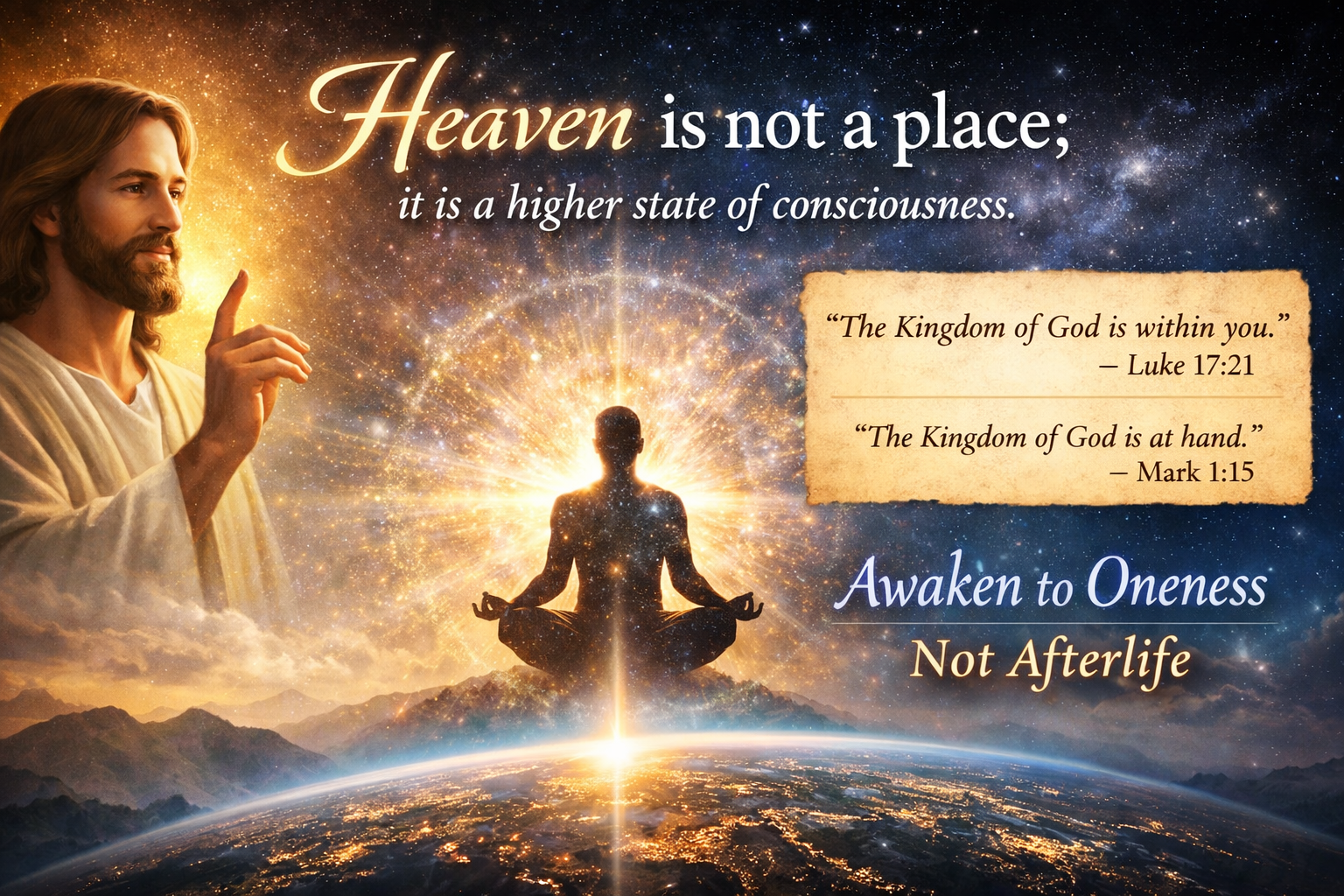
You are likely here from clicking on the top menu link that offers citations/evidence of the claims being made on the very top banner. The reason for this page is due to the inevitable backlash and impulsive reactions to the statements being made as I realize it can be jarring for many Christians who are not used to these ideas circulating the Christian community despite being present in the teachings of Jesus.
The statement “Heaven is not a place; it is a higher state of consciousness” will inevitably unsettle some Christians who were raised to believe that heaven is a post-mortem destination. Yet this discomfort stems not from Jesus’ teachings, but from doctrines introduced long after his death. Jesus repeatedly spoke of the Kingdom of God as present, immediate, and internal, not as a reward deferred until after death.
In Luke 17:20–21, Jesus Christ explicitly states that the Kingdom of God is within you. At no point does he describe it as a location one travels to after dying. This should not be surprising—Jesus consistently taught through symbolism, metaphor, and paradox. A literal kingdom cannot exist inside a person, but a realization can.
Once it is understood that the “Kingdom of God” is symbolic of the universe itself—or the divine totality—its meaning becomes clear. To “enter” the Kingdom is to awaken to unity, to transcend the illusion of separation, and to recognize one’s oneness with all humanity and existence. This is not a future event; it is a shift in awareness.
The belief that heaven arrives only after death is one of many theological alterations introduced by later authorities who appointed themselves interpreters and editors of Jesus’ message. Jesus himself consistently described the Kingdom as “at hand”—a phrase he uses repeatedly, including in Mark 1:14–15. “At hand” does not mean postponed, distant, or conditional. It means present and immediately accessible.
In short, Jesus did not teach people to wait for heaven. He taught them to wake up to it.
Regarding the current iteration of Christianity as a religion, there is the persistent problem within the religion where teachings established years after Jesus died ended up taking hold. There are so many changes, and many of which completely contradict what Jesus taught which unfortunately has surpassed the original teachings of Jesus. The idea of merely believing in Jesus has overtaken actually practicing what Jesus taught and it has become the norm. This of course has led to millions of Christians not awakening to the kingdom of God within them to the point where they assume it must not be something you enjoy now, but when you die. The additions made to the religion need to be identified and abandoned, particularly when they directly violate what Jesus taught which is often the case with Paul’s changes to the religion. It can safely be said that most Christians follow Paul’s religion, not Jesus’.
Feel free to review these two pages which touch on major deviations from the teachings of Jesus which sets the groundwork for how Christianity stopped becoming a religion reflective of the teachings of Jesus. The citations you want are there as well.
Paul’s Changes To Christianity
The final declaration on the top menu “Seek Spirituality NOT Religion” is not some advocacy of a new age movement but rather a restoration of what Jesus taught, and Jesus did not organize or formally begin any religion. He taught spiritual practices but at no point never gave a blueprint for starting an organized religion, church institutions. Jesus was always someone who always operated outside the established religious power structures and challenged them. However, in the years since his death, this has been lost on his followers as they constructed religious institutions/organizations that mirror the ones he challenged. He taught lifestyle changes, not advocating for the proliferation of more religions which leads to more tribalism which is antithetical to what he taught.
This website exists to tear down false assumptions about what Jesus actually taught and to expose how far modern Christianity has drifted from those teachings. Ignoring Jesus’ words because your pastor, denomination, or preferred tradition chose not to teach them is not faith—it is willful dishonesty. And it explains the knee-jerk hostility these ideas provoke, despite Jesus stating them clearly and repeatedly.
Modern Christianity already rests on a foundational distortion: the insistence that Jesus claimed to be God or demanded worship. He did neither. Yet as if that misrepresentation weren’t enough, anything Jesus taught that resembles Eastern philosophy or threatens institutional authority is now lazily dismissed as “New Age.” The result is a grotesque inversion: Christians quoting Jesus while simultaneously rejecting the substance of what he said. We have reached the point where Jesus’ own teachings are treated as incompatible with Christianity itself.
This did not happen accidentally. Christianity has systematically stripped Jesus’ message of its transformative core and replaced it with obedience, dogma, and deferred rewards. If you entered Christianity and were never taught how to access the Kingdom of God within yourself—if your life was not fundamentally altered in consciousness, perception, and inner freedom—then you were never taught what Jesus was actually teaching. That inner awakening was not a bonus feature. It was the entire point.
Today, when people are told that the Kingdom of God is meant to be accessed now, not after death, not through institutions, and not through blind belief, the reaction is not joy—it is resistance. Instead of excitement at the possibility of profound liberation, peace, and clarity, there is fear. Fear of losing inherited doctrines. Fear of dismantling centuries of misinformation. Fear of discovering that much of what was taught was wrong.
Readers of this site have responded exactly this way, even when presented with direct citations from Jesus’ own words. The attachment to ancient but incorrect doctrines is fierce, because identity has been built around them. But tradition does not equal truth, longevity does not equal accuracy, and repetition does not transform error into revelation.
What is being challenged here is not Jesus. What is being challenged is a version of Christianity that quietly abandoned his teachings, replaced them with something safer and more controllable, and then labeled his actual message “dangerous” when confronted with it.
If you enjoy or appreciate what I’m doing on this website, I would appreciate a subscribe! No selling of emails will occur, it’s just for updates.
Also feel free to subscribe to my new Substack! You’ll also find my latest writings published there if you prefer it over WordPress, along with refreshed and updated versions of some of my earlier work, thoughtfully adapted for the new platform. I’d love to have you join me there!
Alternatively, you can subscribe to my traditional email mailing list below! No marketing or selling of emails will occur, it’s just for updates.