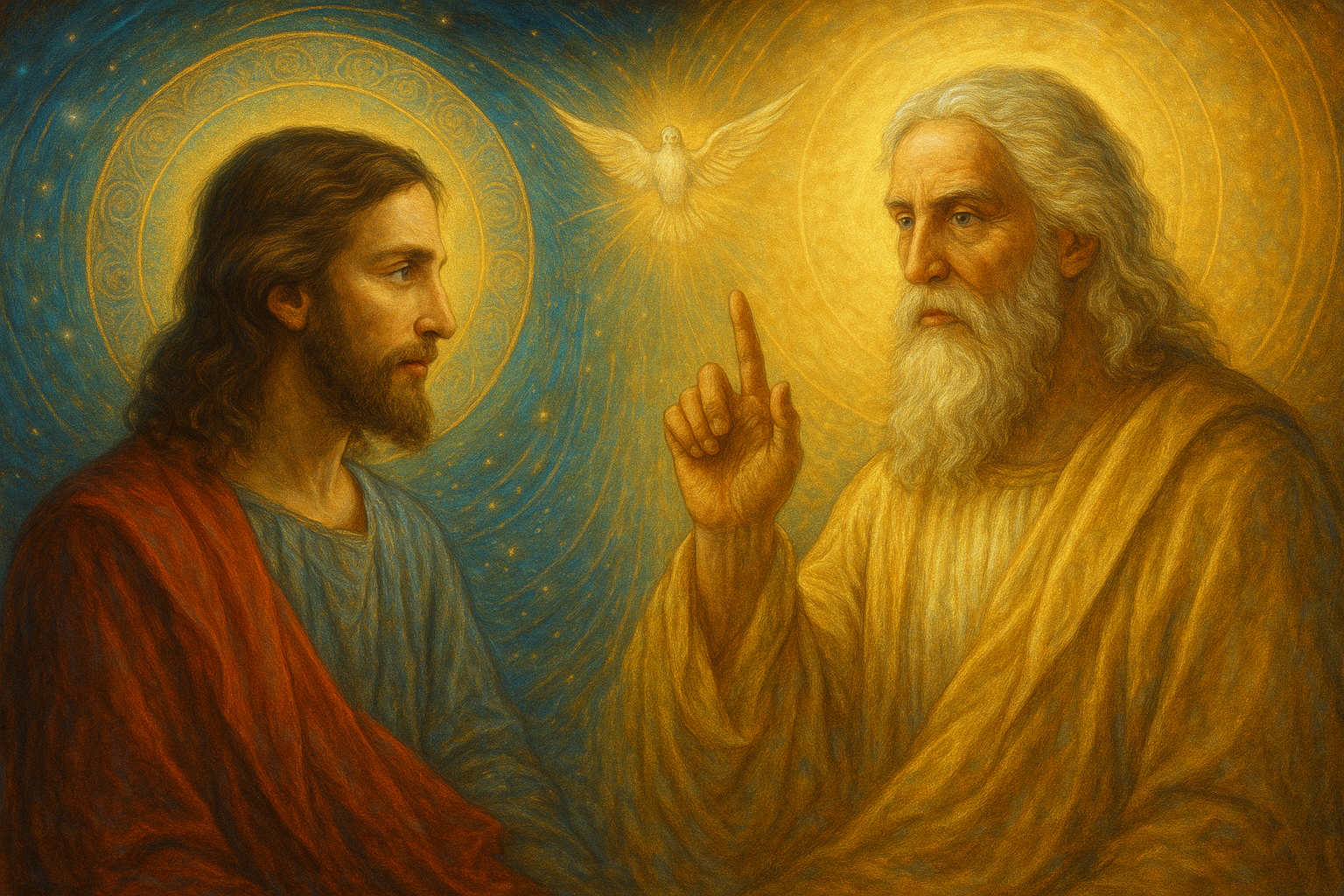
Jesus’ Claim of “Oneness With God” Explained. Jesus Explicitly Distinguishes Himself from God
Jesus was not someone looking for worship or praise, however he was absolutely being guided by God and the Holy Spirit. This is not a controversial interpretation — it is what the Gospels actually show, if you read them honestly. He consistently called himself the Son of Man, a human being, and he repeatedly drew a clear distinction between himself and God the Father. What he was demonstrating was not divinity in the exclusive sense Christianity later assigned him. He was demonstrating what a human being becomes when they awaken to their higher self and access the Kingdom of God and God present within all of us. In short, total unity with all things.
When Jesus said he was “one with God,” he was not declaring himself to be God. He was describing a state — an awakened union with God, the universe, and all of humanity. That state goes by many names across spiritual traditions: enlightenment, ego transcendence, the dissolution of the false self, the return to our deeper and truer nature. Achieving oneness with the universe does not mean you are the universe. It means you have remembered your connection to it. That is precisely the connection Jesus was teaching everyone around him how to access.
The evidence in scripture is consistent.
“My God, my God, why have you forsaken me?” is not the cry of someone who believes himself to be God.
““You would be glad that I am going to the Father, for the Father is greater than I.”
“Why do you call me good? No one is good except God alone” is an explicit deflection of divine status.
“Do not hold on to me, for I have not yet ascended to the Father. Go instead to my brothers and tell them, ‘I am ascending to my Father and your Father, to my God and your God.’”
And when Jesus instructs his followers to
“love the Lord your God with all your heart and with all your soul and with all your mind,”
he is directing that devotion toward the Father — not toward himself.
At no point does he say to followers to “love me with all your heart” or instruct anyone to worship him. That instruction simply does not exist in the Gospels.
He also uses the term Lord to refer to God the Father during his teachings.
I praise you, Father, Lord of heaven and earth…” (Matthew 11:25)
“Worship the Lord your God and serve him only.” Luke 4:8
What does exist is the same spiritual invitation, repeated throughout his ministry: remember your oneness with the universe within you. That is what he called the Kingdom of God. That is the ecstasy he pointed toward when he spoke of heaven — not a gated destination accessible only after death, but a state of elevated consciousness available within each of us, right now. Heaven was always a natural shorthand for what happens when the ego dissolves and the illusion of separation between yourself and everything else finally falls away.
The people around Jesus during his lifetime were so staggered by what he was teaching and demonstrating that they projected divinity onto him — and he declined the label. He consistently redirected praise and worship toward the Father. He acknowledged his role as a teacher and a guide, following the path laid out for him by the Holy Spirit, but he never conflated that role with being God himself. When he said “I Am” in response to being asked if he was the messiah, he was acknowledging his appointed purpose — to awaken people from the darkness of ego — not making a claim of divine identity. The two things are not the same, and Jesus went out of his way, repeatedly, to make that distinction.
The confusion was introduced after his death, when the title “Son of God” was increasingly applied to him by people who had not known him, and ancient texts were translated, reinterpreted, and layered with doctrine he never established. His symbolic language was taken literally. His descriptions of spiritual experience were converted into mythology. And the remarkable thing he was actually pointing toward — that anyone can walk the same path he walked, accept the same guidance of the Holy Spirit, and arrive at the same realization of oneness — got buried under centuries of theological elaboration that made him into an unreachable exception rather than a living example. In short, the title ‘Son of God’ was given to him by others many years after his death, but it was not a title he claimed.
This is the heart of what Jesus was teaching: not worship him, but follow him. Walk the path he walked. Surrender the ego’s insistence that it knows best — “Thy will be done,” said sincerely, is the mechanism — and open yourself to the guidance of the Holy Spirit and the Father. That surrender is what led Jesus to the apex of spiritual enlightenment, and he made clear it was available to everyone.
Someone who achieves genuine oneness with God through ego dissolution and spiritual awakening does not thereby become an object of worship. They become a demonstration of what is possible. That is exactly what Jesus was — and the decision to worship him instead of emulate him is the single most consequential way Christianity misunderstood the man it was built around.
He was walking a path. He was inviting everyone to walk it with him. Two thousand years later, most of his followers are still standing at the trailhead, bowing to the guide instead of taking a single step.






Leave a Reply