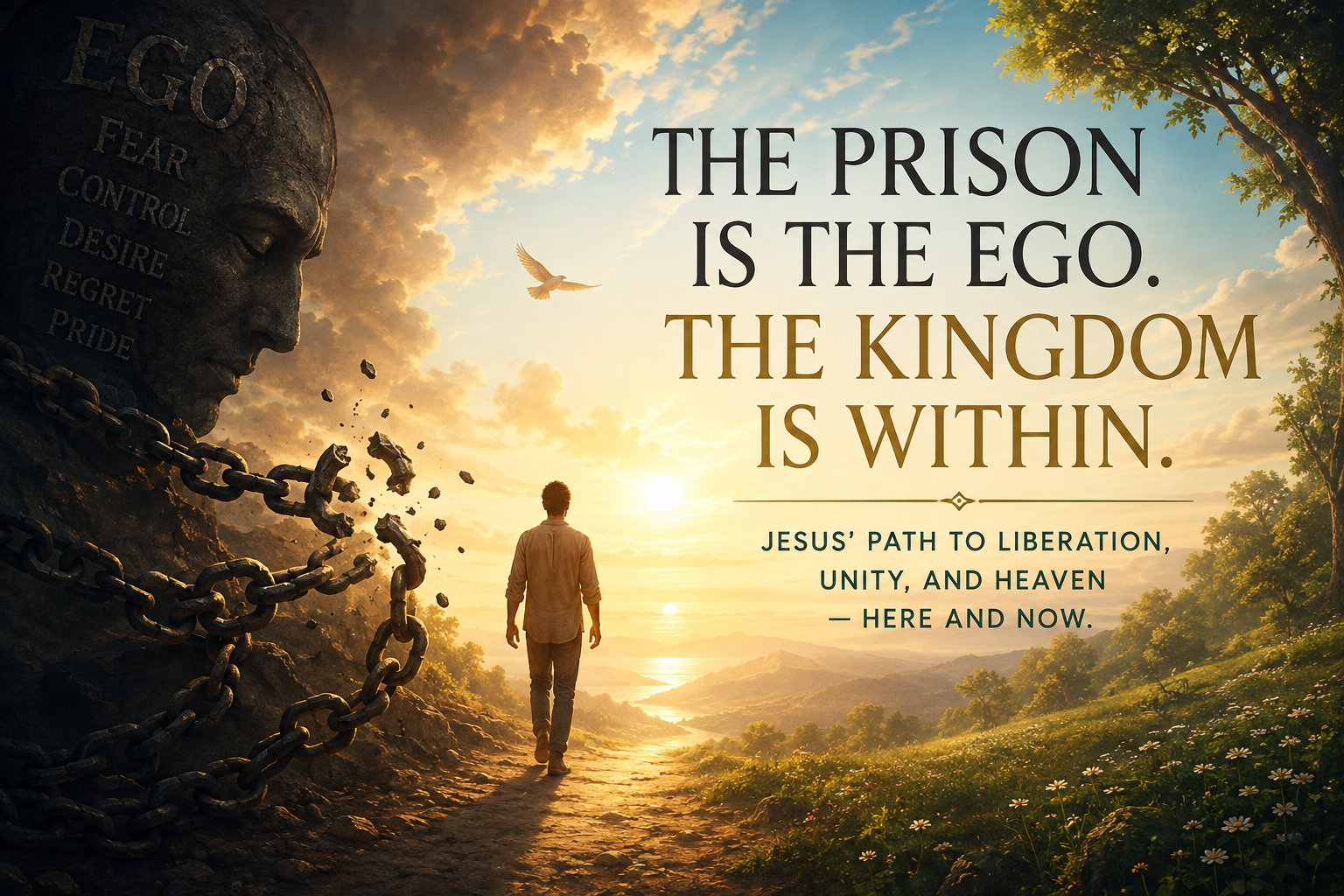
We have been held captive and ensnared by our egos for long enough, never realizing that a more euphoric existence was available beyond the standard egoic consciousness we came to accept as normal, when, in fact, much of it was suffering.
It becomes easy to understand why the ego has been personified in ancient texts and literature for thousands of years as something demonic or monstrous. There was little other way to describe something that feels so real and powerful yet exists entirely within our consciousness. What torments us is not necessarily some external monster, but our own ego and its relentless insistence on maintaining total control over our lives. In truth, liberation begins when we release our desire and demand for that control.
First things first: Open yourself up for relinquishing control. Our ego’s biggest addition. Control is the ego’s only real leverage over us, and taking it away is the first step. This is one of the key declarations made in the lord’s prayer, and it’s not emphasized enough in mainstream Christianity. A declaration to “our father” that “let thy will be done” should be made with a sincere desire to let go of control and ask God to take the wheel instead.
Next: let go of the past, and let go of the future.
You begin to transcend the ego when you stop obeying its insistence that everything must be controlled, predicted, revisited, or feared. Instead, you elect to live in the infinite present. When you are no longer consumed by what has already happened or anxious about what might happen, you can finally live fully in the now—and so much of the anxiety the ego creates begins to fall away. There are tremendous benefits to no longer being stuck in the past, though it can be difficult. For those who have been hurt badly, this is where forgiveness does its work.
The next step is to invoke the Spirit of the universe and welcome it within you, sincerely asking it to guide you and keep you in harmony with God’s will and plan for you. A sincere invocation is necessary. You are not simply asking for assistance while continuing to demand control over everything that happens, you are willingly surrendering that control and allowing yourself to be guided. Simply declare in your words, with sincerity and humility in your consciousness that you surrender your will and welcome the holy spirit within you, to guide you on the path our source has planned for you and declare that you yield to his will completely. Declare this in your consciousness as often as possible, especially in moments where you feel guidance and help is needed. We cannot do everything ourselves, and recognizing that is humbling, especially when we open ourselves for guidance and help.
This will be difficult for many people because the ego cannot fathom relinquishing control. It has spent your entire life convincing you that control is necessary for your survival, your security, and your happiness. But releasing that control is precisely what is necessary.
The result can feel like liberation from captivity, as though you have finally escaped an abusive relationship that you did not even realize was not normal. The ego that demanded, worried, judged, feared, regretted, anticipated, and attempted to control everything begins to lose its grip. In its place can emerge a state of peace and bliss that you may not have even known was possible.
These instructions are not emphasized nearly enough in modern Christianity. The surrender of control—the willingness to relinquish the ego’s demands and entrust yourself completely to God—is too often overshadowed by doctrines, institutions, rituals, and demands for belief.
And beware of wolves in sheep’s clothing in religious institutions who only want your money yet fail to guide you toward the path Jesus actually taught. Jesus’ mission was not simply to amass a movement of people who would worship him. His message showed people a way out of captivity: surrender, forgiveness, love, detachment from worldly treasures and status, freedom from judgment, and complete trust in God.
The proper path for a Christian is not just about declaring that you believe in Jesus. It is about living according to the ways he taught and allowing that to transform your consciousness and set you free. He was not going around asking to be worshiped; he was teaching people to experience the same liberation he had found through that surrender. He was teaching others to surrender to the plan the universe intended for them, in much the same way Jesus was following a very specific life story and goal assigned to him. We all have a life trajectory we are intended to follow, and you can either try to personally dictate every step of your life, or ask to be guided on the course that was intended for us. The latter brings you the most happiness, when you yield to that guidance.
That liberation from the ego is what has so often been described as Heaven—the Kingdom of God within all of us, waiting to be accessed. It is not a destination awaiting us after death, but a state of being available here and now.
Atheists have long asked Christians how they can possibly prove that heaven comes after you die. The honest answer is that they can’t, and they don’t need to. Heaven is a higher state of consciousness that is reproducible and verifiable now, in this life, by anyone willing to faithfully follow the instructions. You don’t have to wait for death to find out. You can experience it while you’re alive. There are have also been multiple studies that have recorded the experience on a biological level when the person successfully triggered a spiritual awakening (heaven/nirvana), with researchers documenting measurable changes in brain activity and physiology.
The experience can be described as a profound sense of unity with the entire universe and with all of humanity. From that state, you begin to understand why Jesus spoke of others as our brothers and sisters. The reality is that we are all quite literally united as one. It is only our egos that have convinced us that we are fundamentally separate from one another.
That illusion of separation has, in turn, allowed human beings to become selfish, malicious, judgmental, greedy, and destructive. We convince ourselves that another person’s suffering is separate from our own, that another person’s life has nothing to do with ours, and that we can harm others without ultimately harming ourselves. But those qualities begin to dissolve when we access that state of Heaven within us, because once you experience that unity, treating another human being with cruelty becomes increasingly incompatible with how you understand yourself and the world around you.
This is the Kingdom of God within us that Jesus was teaching humanity to access. It is not simply a reward waiting somewhere beyond this life. It is something available to us in this life, in this moment.
Not after you die.
Today.
Feel free to subscribe to my new Substack! You’ll also find my latest writings published there if you prefer it over WordPress, along with refreshed and updated versions of some of my earlier work, thoughtfully adapted for the new platform. I’d love to have you join me there!
Alternatively, you can subscribe to my traditional email mailing list below!
recent articles:
Recomennded articles:





Leave a Reply