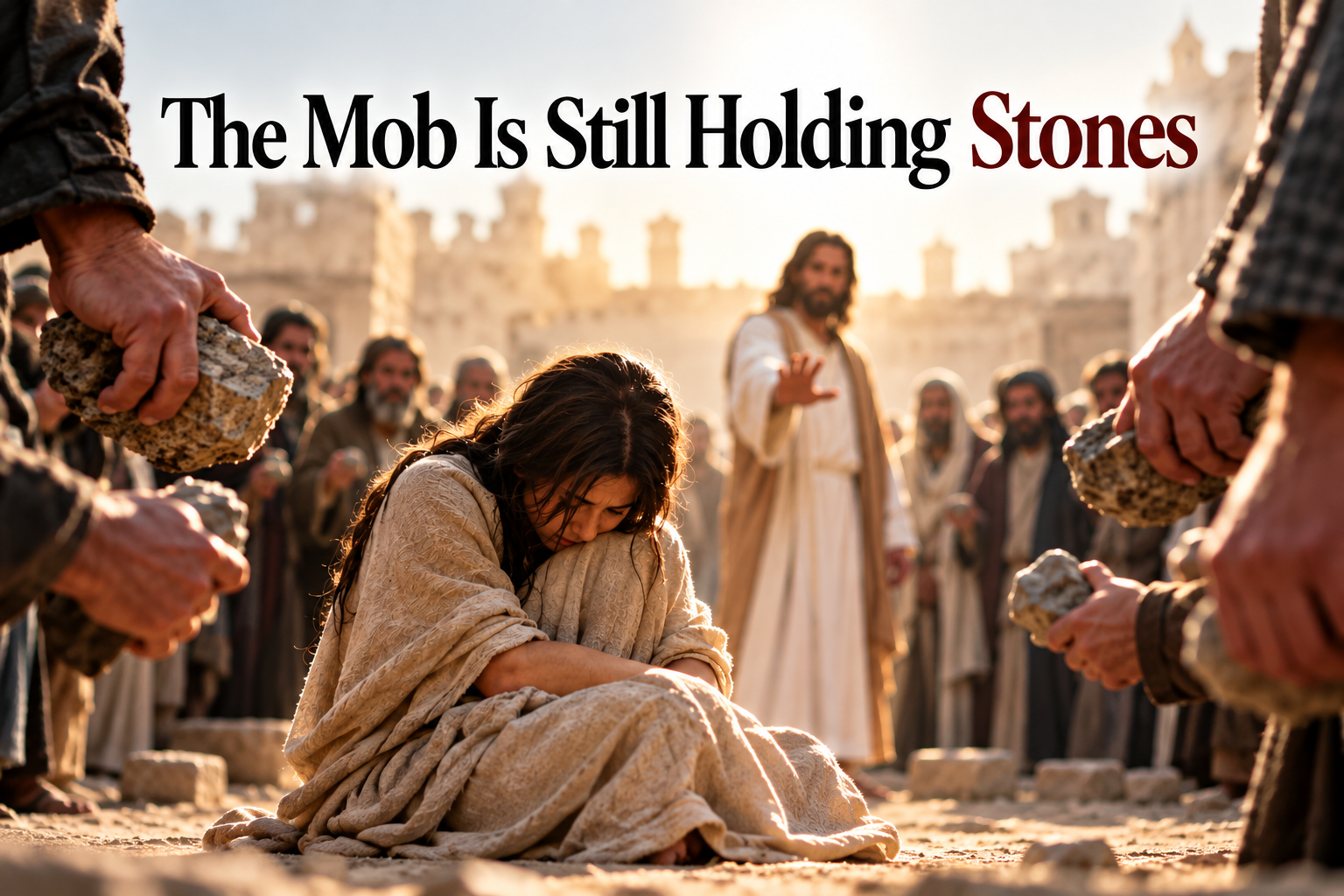
The Mob Is Still Holding Stones
It’s remarkable how clearly the story of Jesus and the woman caught in adultery plays out in our own time. You can see a vivid parallel in the way some Christians treat people whose lives they consider sinful.
Most Christians know the story. A crowd drags a woman before Jesus, ready to stone her. Instead of joining them, Jesus turns the question back on the accusers: “He that is without sin among you, let him first cast a stone at her.” One by one, they walk away.
So I have to ask: when Christians gather in angry crowds to protest LGBT people, how many of them are actually applying this teaching? Taken seriously, it would leave every faithful Christian with nothing to throw.
Some will answer, “But we have to speak up so they’ll turn from that lifestyle.” Look at how the story ends, though. Once the crowd is gone, Jesus tells the woman, “Neither do I condemn thee.” He protects her from violence and refuses to condemn her, because judgment belongs to God alone. The crowd, meanwhile, was doing exactly what Jesus wouldn’t: judging her without first examining themselves.
Notice, too, what Jesus didn’t tell the crowd to do. He didn’t ask them to educate the woman about her sins, persuade her to change, or keep confronting her until she repented. He asked them to look at their own lives. And when they walked away, they did what his challenge called for: they put down their stones and left her in peace. A faithful application of his teaching, then, is honest self-reflection, not confrontation. In our own time, that means not harassing people over who they are.
Yes, Jesus tells her to “go, and sin no more.” But that instruction was given to someone who had betrayed a spouse. Is it fair to compare that with a person’s sexual orientation? Adultery is a choice to break a promise. Orientation, as research has consistently found, is not something people choose, and efforts to change it have a long record of failure. Whatever the reasons someone turns out the way they do, and science may not fully know yet, the evidence that it can’t simply be switched off is right in front of us.
Consider the many gay Christians. Recent data suggests that around 38% of LGBT people identify as Christian. Perhaps it was Jesus’s call to love your neighbor and not to judge that drew them in, which is exactly what every Christian should be practicing. Their faith didn’t suddenly make them straight, however most Christians would assume it would. That alone tells us something about how deeply attraction is rooted in a person.
I welcome their presence in the world’s population. They reveal which of us would have stood in the crowd Jesus rebuked, and which of us actually follow his benevolent instructions. For many Christians, this should serve as a red alert, making them aware they’ve fallen out of line with the teachings of Jesus.
And to those who worry that being around gay people might somehow “rub off” on others: that isn’t how attraction works. No one persuades a straight person into being attracted to the same sex. You’re drawn to who you’re drawn to.
Picking and choosing
This raises another question: how do Christians decide which Old Testament laws still apply and which don’t?
Leviticus, the same book often cited against gay people, also forbids eating pork and shellfish, wearing clothing woven from two kinds of fabric, and much more. Most Christians have quietly set those rules aside. Apparently, we love pork too much to give it up, and whatever else Leviticus prohibits that we still choose to enjoy. Yet many of those same Christians insist that the verses about homosexuality must stand, even though they target something people can’t control.
So if Christians feel they have the authority to set aside the law against pork, why not apply that same reasoning to the laws against gay people? When one rule is dropped without a second thought and another is held up as non-negotiable, it’s hard not to wonder whether something other than scripture is doing the choosing. For some, it seems the real driver isn’t faithfulness to the text but a hatred and bigotry towards gay people, and it comes through in how they speak and act toward them.
The bigger lesson
Beyond any single issue, the heart of this story is simple: examine your own faults before you judge anyone else. That’s something all of us need to practice every day, even in small moments.
Someone cuts you off in traffic. Your first instinct is probably anger. Instead, let it remind you of the times you’ve done the same thing, and let that be your cue to forgive. Someone tells you a white lie? Think of the white lies you’ve told. Someone snaps at you, gets condescending, or gets sarcastic? Forgive them, reflect, and move on. Never let these incidents get under your skin. They are prompts for reflection that should not be squandered.
These moments come up constantly, and each one is an invitation. Why do they keep happening? Because we’re all connected. Others reflect ourselves back to us, and what irritates us in them often shows us something in ourselves. So welcome these moments when they arrive. They’re opportunities to see your own weaknesses more clearly. Don’t hesitate to ask God for help revealing your weaknesses to you in future instances similar to the ones I described.
The goal is simple: never go from zero to sixty in anger. Increase your self-awareness. Pause, honestly reflect, forgive.
For newcomers to my site, I highly advise reviewing my checklist of declarations to the universe to achieve absolute oneness with all
Citation supporting percentage of LGBT persons who identify as Christian.
https://prri.org/wp-content/uploads/2026/04/PRRI-Apr-2026-Census-of-American-Religion-final.pdf
Feel free to subscribe to my new Substack! You’ll also find my latest writings published there if you prefer it over WordPress, along with refreshed and updated versions of some of my earlier work, thoughtfully adapted for the new platform. I’d love to have you join me there! (No charge to subscribe)





Leave a Reply