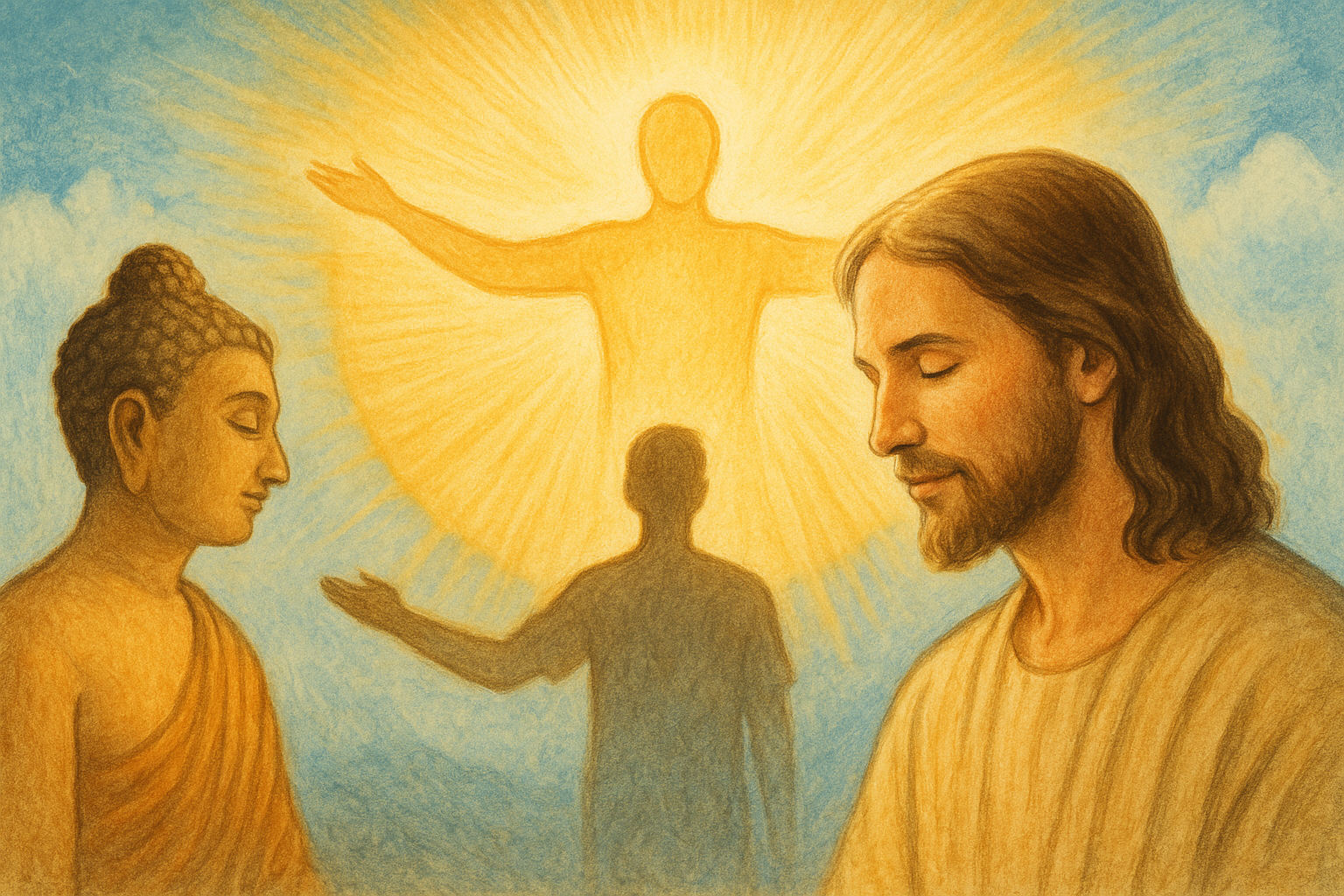
Despite what many religious scholars or mainstream Christians may believe, the teachings of Jesus are not rooted in dualism–the idea that God and humanity are fundamentally separate. In fact, when properly understood, the message of Jesus aligns remarkably with nondual traditions like Buddhism, which recognize that all beings are intrinsically one with the source of all existence.
Jesus, a master of poetic and metaphorical language, often described our relationship with God using familial imagery–calling us “children of the Father.” This metaphor is not meant to imply separation, but rather deep unity. To say we are children of God is to affirm that we originate from, and are expressions of, the same divine essence. Put more literally, we are not separate from our source–we are our source, experiencing itself through infinite points of view.
This is the very heart of nondualism: the realization that there is no ultimate division between God and creation, between self and other. The ego may try to convince us otherwise, insisting on our separateness, but that illusion dissolves in the light of a spiritual awakening.
When viewed through this lens, Christianity, at its mystical and authentic core, is a nondualistic faith. Jesus awakened to this truth himself and spent his ministry guiding others toward the same realization. His teachings were not about establishing a religion of worship and separation, but about helping people remember their oneness with God, with each other, and with all of creation.
In this way, Jesus stands shoulder to shoulder with the great sages of the East. His message was not one of exclusion, but of unity. Not of division, but of wholeness. He didn’t simply proclaim that he was one with the Father–he taught that we all are.
Many Blessings Your Way! Join my mailing list if you want occasional updates.
I do not spam email boxes and will not try to sell you anything!




Leave a Reply