
Is America really built on Christianity? If so, we have to ask ourselves: what kind of Christianity are we talking about?
Look at the history, the genocide and displacement of Native peoples, slavery, Jim Crow laws, and generations of racist policies and institutions. Even today, we have pastors preaching sermons that promote racial division and insist on preserving a predominantly white population, as though this somehow represents the teachings of Jesus. How can teachings like those of Doug Wilson be reconciled with a man who taught people to love their neighbors, love their enemies, forgive others, care for the poor, and reject hatred and division?
This is hardly a new phenomenon. Christians once repackaged colonialism as a God-given right, even when it involved conquering, exploiting, and killing entire populations of people. One of the recurring themes throughout much of Western Christian history has been humanity taking some of its worst impulses and giving them the blessing of God. Greed becomes prosperity. Conquest becomes divine destiny. Racism becomes God’s natural order. Violence becomes righteous self-defense. Tribalism becomes faithfulness.
In other words, Christianity has repeatedly taken some of the darkest impulses of humanity and reframed them as things God supposedly wanted.
That is why I increasingly believe Christianity as an institutional religion has very little to do with actually following Jesus. Ironically, spiritual paths such as Taoism and Buddhism can sometimes appear much closer to what Jesus taught than Christianity itself. In modern America, it isn’t even uncommon to find atheists whose values more closely resemble the teachings of Jesus than those of people loudly proclaiming themselves Christians.
We see this contradiction everywhere. Incredibly wealthy Christians openly celebrate money, wealth, and materialism despite Jesus repeatedly warning against attachment to material possessions. We see mainstream Christians proudly holding firearms in the air despite Jesus teaching non-retaliation, telling his followers to put down the sword, and warning that those who live by the sword will die by it.
There is a reason Jesus became known as the Prince of Peace.
If Christians genuinely want to emulate Jesus, they can start by putting down their weapons, detaching themselves from wealth, loving their enemies, forgiving people, and helping the poor. But good luck telling mainstream American Christians to put their guns down.
Ask your neighborhood gun fanatic whether they would sell all their guns. If they say they need them to protect their family, ask how they reconcile that with their faith’s teachings on violence and retaliation. More often than not, you’ll discover that the guns are non-negotiable. The teachings of Jesus, apparently, are negotiable.
We have now reached the bizarre point where Christian pastors and ministers literally walk onto stages carrying firearms and proudly boast about them while simultaneously claiming allegiance to a man remembered as the Prince of Peace.
That contradiction exposes the larger problem: many Christians are cherry-pickers. They follow the portions of the Bible that conform to their lifestyle, politics, prejudices, and personal beliefs while finding ways around the teachings that would actually require them to change.
Can someone meaningfully call themselves a follower of Jesus if they refuse to adopt his teachings whenever those teachings become inconvenient?
You can see this play out in street interviews all the time. Christians are confronted with contradictions between what they profess and what Jesus taught, and there is rarely a satisfying answer. Sometimes they simply walk away. That is because answering honestly would require confronting an uncomfortable possibility: perhaps their identity as a Christian matters more to them than actually following Jesus.
And that, to me, is the central problem with American Christianity.
It has become an identity. A tribe. A political affiliation. A cultural label. People can call themselves Christian while rejecting the teachings attributed to Jesus whenever those teachings interfere with their preferred way of life. Meanwhile, they can search the rest of the Bible for passages they believe permit them to be as hateful, prejudiced, violent, wealthy, or exclusionary as they want.
The key, in my view, is letting go of religion itself as another form of human tribalism and instead recognizing that we are all one. Christians don’t need another religious identity. They need to drop the label and simply practice the teachings of Jesus.
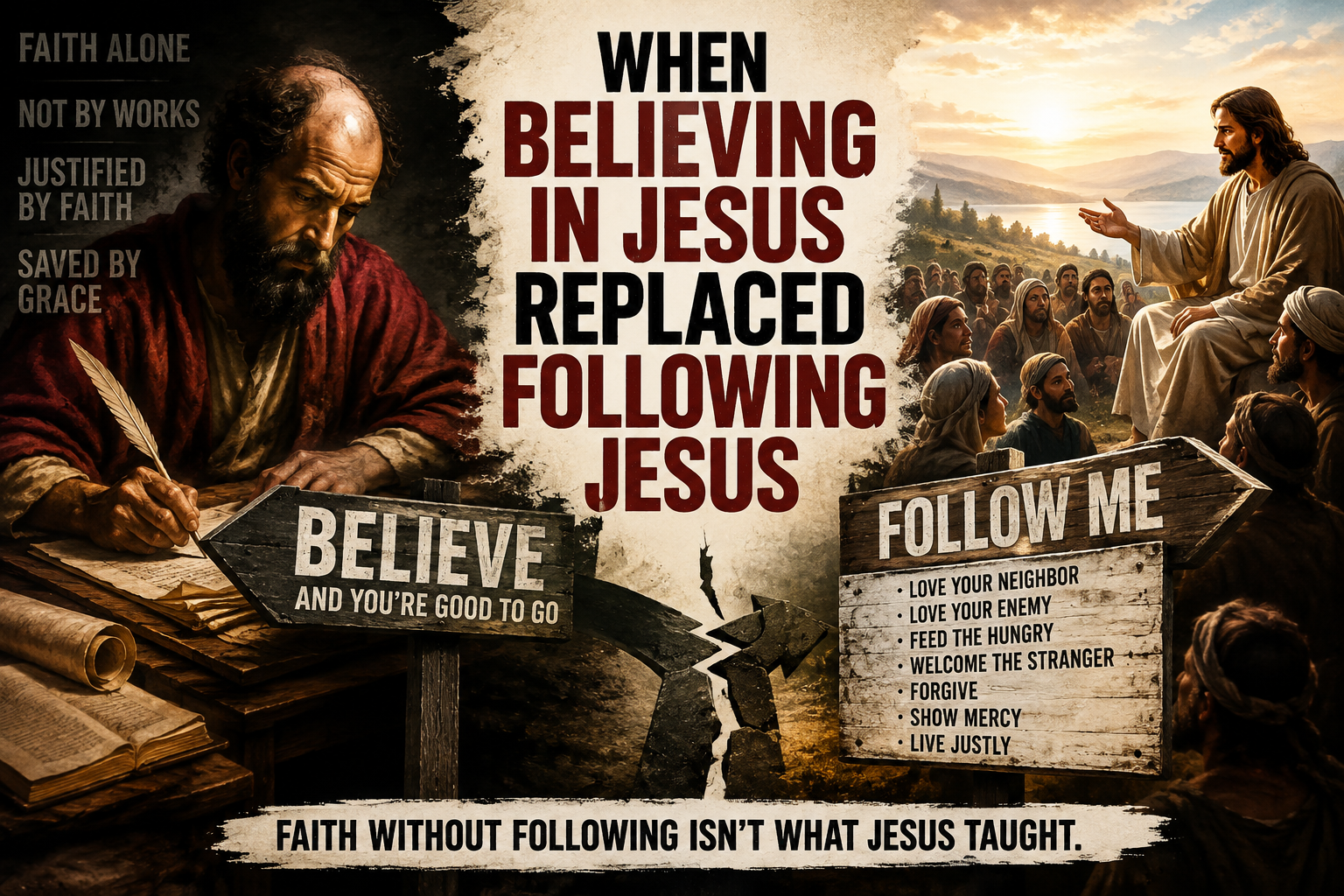
Love everyone. Forgive. Do not judge. Reject retaliation. Help the poor. Release your attachment to wealth and material possessions. Treat other human beings as extensions of yourself.
And that also means having the courage to acknowledge that ancient religious texts containing ideas fundamentally incompatible with those teachings do not suddenly become moral simply because they appear in the Bible.
I’m looking at you, Deuteronomy.
The teachings that matter to me are the teachings attributed directly to Jesus. And if doctrines and theological additions developed years after his death contradict those teachings, I see no reason they cannot be discarded as well.
I’m looking at you, Paul.
If Christianity wants to claim Jesus, then perhaps Christianity should finally start following him.

Leave a Reply