How Christianity Lost Its Way by Taking Its Symbols Literally
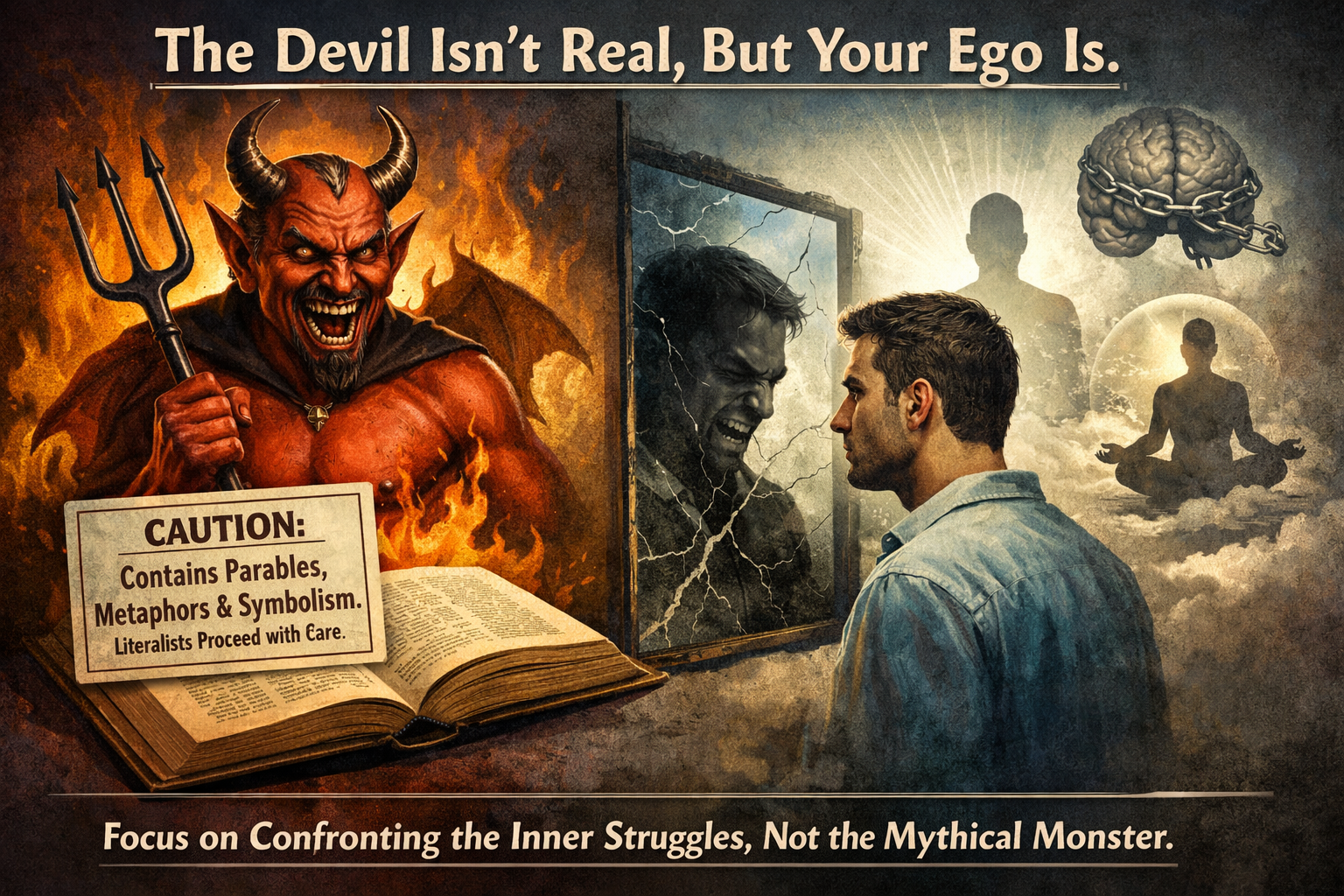
The Bible should come with a warning label: “This text contains extensive use of parables, metaphors, and symbolism. Literalists, proceed with caution.”
Satan, as depicted in scripture, was never meant to be a literal horned figure with a pitchfork. That imagery was a tool — a way of personifying abstract internal forces for ancient audiences who relied on symbolic storytelling to make sense of the human condition.
What the figure actually represents is the human ego: the internal voice that generates separation, pride, fear, and the compulsion to control. By turning that symbol into a literal supernatural villain, Christianity inadvertently led its followers away from the very problem they needed to confront. You cannot address the true source of human suffering if you’ve been taught to blame it on a mythological monster.
An honest minister would say something like this: “There is no devil. There is only the ego — the part of your mind that constructs a story about who you are and works constantly to protect that story from anything that threatens it. It’s not evil. It’s just trying to keep you safe. But if you let it run your life, it will make you anxious, defensive, and disconnected from your deeper self. Learning to notice when the ego is reacting gives you the freedom to choose how you actually want to respond.”
That is the teaching. The talking serpent was just the delivery mechanism.
Both atheists and literalist Christians tend to miss this, approaching the same texts from opposite errors. Atheists dismiss the Bible as failed mythology — critiquing its stories as bad history, judging poetry for not being journalism. Literalist Christians insist the stories must be factually true, fearing that symbolic interpretation somehow endangers their salvation. Neither position engages honestly with what these texts actually are: allegories addressing human nature, spiritual evolution, and the eternal struggle between ego and higher consciousness. The question to bring to these stories is never “did this happen?” It is “what truth is this trying to reveal?”
Nowhere is this more important than in Genesis. The story of Adam and Eve announces its symbolic nature immediately — through a talking snake, through a magic tree, through narrative structures that closely parallel earlier Sumerian legends about a paradise called Dilmun. It is a parable about the emergence of ego consciousness: the shift from a state of unified, ecstatic awareness into the fragmented, self-protective, identity-driven mode of existence that now dominates human life. The fruit of the Tree of Knowledge represents the birth of intellect and individualism. Being cast out of paradise is not a literal expulsion — it is a metaphor for the loss of inner peace and unity that occurs when ego and intellect displace spiritual consciousness as our primary way of being.
The ego, in this framework, is what the story calls Satan: not an external demon, but the internal force that tempts us toward separation, control, and self-definition at the expense of our connection to everything else. Original sin is not a supernatural stain inherited at birth. It is the human condition of living under ego’s dominance rather than in conscious union with the universe.
Using this story to reject evolution or dispute the age of the Earth is to miss its point entirely. The resistance to symbolic reading appears, almost without exception, to be rooted in fear — specifically, the fear of hell for interpreting allegory as allegory. Yet nowhere in scripture is there a stated punishment for doing so. That requirement was never there. It was assumed, enforced through institutional pressure, and internalized by generations of Christians who were never encouraged to read carefully enough to notice its absence. Ironically, this fear-driven literalism is itself a violation of one of Jesus’ most consistent instructions: let go of fear.
The same symbolic logic applies to the Tower of Babel — an allegory for humanity’s fragmentation into separate tribes and languages, serving ancient societies as a framework for understanding what we now call diachronic linguistics. And to the flood narrative, which appears across multiple ancient cultures, most notably predating Genesis in the Epic of Gilgamesh. These are not competing historical accounts. They are parallel mythological expressions of shared human experience.
What makes literalism particularly damaging is what it does to the teachings of Jesus specifically. He was, without question, a teacher who communicated through parable, symbolism, hyperbole, and metaphor. His figurative language wasn’t decorative — it was the vessel of the message. Strip it of its symbolic intent and you don’t get closer to what he meant. You get a distorted, often dangerous caricature. “I came not to bring peace but a sword” is perhaps the most egregious example: a statement that biblical scholars broadly understand as describing the disruptive social consequences of his teachings, routinely cited by those wishing to argue that Jesus was not a pacifist. He was. The sword was never literal.
His reference to “our Father” follows the same pattern. It was symbolic language for the universal Source present in all things and all people — the reason he consistently taught his followers to see one another as brothers and sisters. We are all reflections of the same origin. That oneness is not a theological abstraction. It is an experience — reproducible, documented across spiritual traditions, and reported consistently by those who have genuinely pursued ego dissolution. When Jesus declared himself “one with the Father,” he was describing that experience of awakened unity, not claiming to be God. That distinction cost him his life: the authorities who crucified him heard a claim of divine identity rather than a teaching about universal oneness available to everyone. The misreading was lethal then. Its echoes have shaped Christianity ever since.
A healthier engagement with the story of Adam and Eve — and with the Bible as a whole — would be to let it point toward what it was always pointing toward: the path back to the state of higher consciousness that ego and intellect displaced. Jesus provided the methodology. Relinquish control. Loosen attachment to identity and ego. Practice forgiveness, compassion, and unity. These are not uniquely Christian instructions — they appear across spiritual traditions worldwide and they work consistently wherever they are genuinely practiced.
The tragedy of mainstream Christianity is not that Jesus’ teachings are ineffective. It is that they have rarely been taught accurately enough to be tested. When the focus shifts to affirming the literal truth of ancient parables and declaring belief in Jesus as the sole requirement for salvation, the actual path he described goes unwalked. And people conclude, reasonably, that it leads nowhere — when in reality they were never shown where it begins.
The ego is the source of human suffering. The ancient writers knew it. Jesus knew it. The Buddha knew it. Every genuine spiritual tradition has known it. They all dressed the insight in different language and different narrative, but the target was always the same. Projecting that source onto a mythological demon with a pitchfork doesn’t just make religion less credible. It leaves humanity without a real solution to a real problem.
The solution has always been internal. The stories were trying to say so all along.
Other notable examples Include:
- Plato’s Allegory of the Cave (380 BCE)
- The Epic of Gilgamesh (Mesopotamia) (2100 BC)
- The Story of Narcissus (Greek Mythology) (8 BC)
- The Bhagavad Gita (Hinduism) (400 BC)
- The Tower of Babel (Hebrew Bible) (600 BC)
- Icarus and Daedalus (Greek Mythology) (8 CE)
- The Descent of Inanna (Sumerian Mythology) (1900 BC)
- Laozi and the Tao (Taoist Philosophy) (600 BC)
- Prometheus (Greek Mythology) (700 BC)
In truth, the human ego lies at the root of countless problems we face as a species. Yet unless we set our sights on the true source, we can never hope to address it. When we project blame onto a fantastical caricature of evil, religion loses credibility and humanity is left without real solutions. The struggles born of ego are not the work of some external boogeyman, they are deeply human, well-documented through psychology and therapy alike. Many authentic spiritual traditions understand this and provide practical, time-tested paths for transcending the ego. Their wisdom also does not point us toward mythical demons, but toward honest self-confrontation and inner transformation.
Literalists Need To Approach The Bible With Care and The Importance of Identifying Figurative Language
If you read the Bible, read it as Jesus taught— Symbolically
The Bible was not written as a history textbook, and treating it like one is one of the most persistent and damaging mistakes in modern Christianity. Its authors were creative, symbolic thinkers who used metaphor, allegory, parable, and poetic narrative to convey spiritual truths that resisted straightforward description. To read those devices literally is not reverence. It is a fundamental misreading of what the text is doing — and it causes the actual meaning to vanish entirely.
Jesus was himself a profoundly symbolic communicator. He taught almost exclusively through parable, metaphor, hyperbole, and figurative language. His words were designed to point beyond themselves, toward deeper truths about consciousness, ego, unity, and the nature of God. Strip that symbolic layer away and you don’t get closer to what he meant. You get a distorted surface reading that can be — and has been — used to justify almost anything.
The most glaring example is the line “I came not to bring peace, but a sword.” Biblical scholars are in overwhelming agreement that this was symbolic language describing how his teachings would inevitably disrupt and subvert the religious and political establishment of his time. Yet it is regularly cited by those eager to argue that Jesus was not a pacifist — a conclusion that requires ignoring virtually everything else he ever said. This is what happens when metaphor is flattened into literalism: the meaning inverts.
At the root of this literalism is fear — specifically, the fear of eternal punishment for interpreting the text incorrectly. This is deeply ironic, because Jesus repeatedly and explicitly taught his followers to release fear entirely. The insistence that every passage must be read as historical fact is itself a violation of one of his most consistent instructions. And nowhere in scripture is there an actual warning that interpreting allegory as allegory results in divine punishment. That requirement was never stated. It was assumed, enforced through institutional pressure, and swallowed by generations of Christians who were never encouraged to read carefully enough to notice its absence.
Genesis is the clearest test case. The story of Adam and Eve announces its symbolic nature from the outset — a talking serpent is not a historical detail, it is a literary signal. The narrative is a profound allegorical account of humanity’s shift from unified, egoless consciousness into the ego-driven, self-defining mode of existence that now dominates human life. God casting humanity out of paradise is not a literal expulsion. It is a metaphor for the loss of inner peace and bliss that results from elevating ego and intellect above spiritual awareness. The story ends with the ego prevailing — and the entire arc of Jesus’ teachings is, in essence, the path back from that fall.
Using this story to reject the scientific evidence for evolution entirely misses its purpose. The resistance to symbolic reading is, again, rooted in fear rather than genuine engagement with the text. A more honest and spiritually productive response to the Eden narrative would be to let it inspire the desire to return to the state of higher consciousness it describes — using the methods Jesus actually taught: relinquishing control, loosening attachment to ego and identity, and opening to the Spirit’s guidance.
The same symbolic lens applies to how Jesus referred to God. “Our Father” was not a claim about a literal paternal figure. It was symbolic language for the universal Source present in all things and all people — the reason Jesus consistently taught his followers to see one another as brothers and sisters. We are all reflections of the same origin. When he declared himself “one with the Father,” he was describing the experience of awakened unity with the universe, not claiming exclusive divine identity. That misreading — driven by literalism — contributed directly to his execution. The authorities heard a claim of divine supremacy rather than a teaching about universal oneness available to everyone. The consequences were fatal.
The tragedy of mainstream Christianity’s literalism is that it has caused people to leave the faith concluding that Jesus’ teachings simply don’t work — when in reality, the teachings were never accurately transmitted. The focus shifted toward affirming the literal truth of ancient narratives and away from actually practicing the principles those narratives were designed to convey: unity, forgiveness, compassion, ego transcendence, and love. Confirming that a talking snake was real is not a spiritual practice. Living what the story points toward is.
Leading a life in genuine accordance with what Jesus taught matters infinitely more than affirming that every passage in the Bible happened exactly as written. The symbolism, parables, and metaphors he employed were never meant to be endpoints of belief. They were invitations — into a deeper understanding of our shared oneness, and into the direct experience of the unity he spent his life trying to show us was already there.
Many Blessings Your Way! Join my mailing list if you want occasional updates.
I do not spam email boxes and will not try to sell you anything!
Relevant Posts Below






Leave a Reply