
There is only one Source. Call it God, the Tao, Brahman, the Ground of Being — the label changes nothing about the reality it points toward. The moment we begin arguing that our particular name for the infinite is the correct one, we have already missed the point entirely.
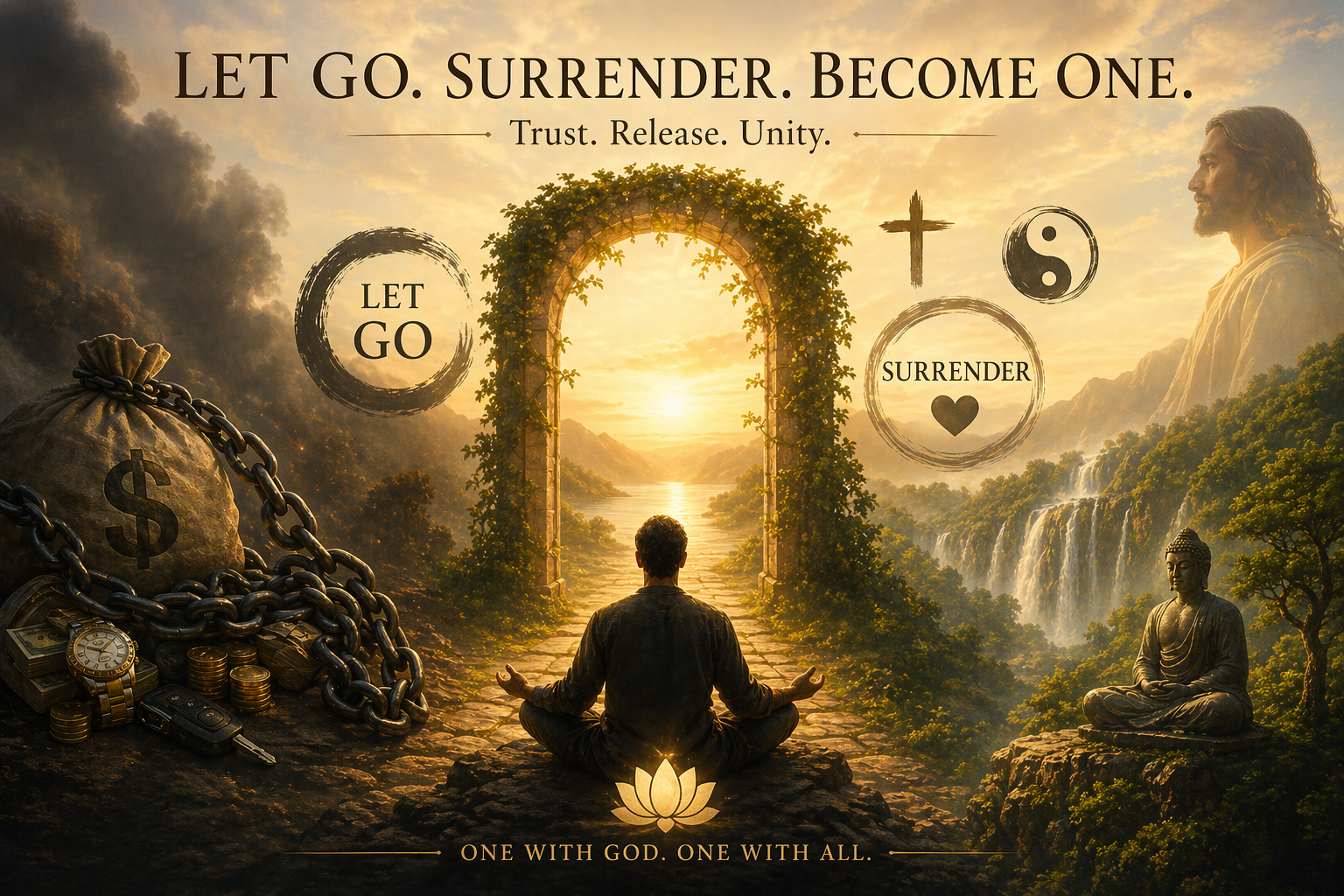
The greatest spiritual traditions of the world are not competing franchises. They are different maps drawn by different cartographers, each describing the same vast territory of inner transformation. Buddhism charts the dissolution of the ego-self through mindfulness and the recognition of impermanence. The mystical teachings of Jesus speak of dying to oneself, of the Kingdom of Heaven dwelling within, of loving one’s neighbor as an extension of loving God. Taoism describes effortless alignment with the flow of existence. These are not contradictory doctrines — they are converging roads.
To walk one of these roads with sincerity is not to betray the others. You are not dishonoring Jesus by sitting in meditation. You are not abandoning the Christ when you study the dharma. If anything, you are honoring the deeper intention behind his teachings by refusing to let them be hollowed out into tribal identity markers.
The Problem With Spiritual Tribalism
What institutional Christianity has too often sold its followers is not a spiritual path but a membership. Allegiance to the club became more important than the transformation the club was supposedly designed to produce. And the most effective way to enforce that allegiance was fear — the suggestion that exploring any other tradition constituted betrayal, heresy, or worse.
But consider what this argument actually implies. If Jesus taught practices of inner stillness, forgiveness, ego surrender, and unconditional love — and if those same practices appear in Buddhism, in Vedanta, in Sufism — then dismissing those traditions as false does not elevate Jesus. It diminishes him. It suggests that the universal truths he embodied were somehow his private intellectual property rather than expressions of the one reality available to all sincere seekers in every age.
You cannot claim your map is the only correct map while other cartographers are charting the same mountain.
One Destination, Many Paths
The goal has always been the same: awakening. The dissolution of the false, contracted self and the recognition of what was always already present beneath it. Jesus called it the Kingdom. The Buddha called it nirvana. The Vedantic sages called it moksha. The Sufi mystics called it fana — annihilation in the divine.
Different words. The same silence on the other side of them.
This does not mean all paths are equally suited to every person. The invitation is not to practice everything at once in a kind of spiritual buffet, but rather to ask — sincerely, openly — which path speaks most directly to your nature. For some, the devotional heart of Christian mysticism will be the doorway. For others, the clean precision of Buddhist practice will cut most directly through the noise. Ask the Source itself to guide you. It will not mislead you based on which tradition you were born into.
What you can release, without guilt and without apology, is the fear that genuine seeking will lead you away from truth. It will not. Every authentic tradition makes the same promise: go deeply enough inward, and you will find what you were looking for. The teachers may wear different robes. The language may shift. But the light at the end of every honest inward journey is the same light.
There is no separate Buddhist God and Christian God dividing the cosmos between them like rival landlords. There is only the one reality, endlessly patient, available to whoever turns sincerely toward it — regardless of which road they happen to be walking.
Why Isn’t Christianity Working?
It is a question that deserves to be asked plainly, without defensiveness and without apology: why are practitioners of Buddhism, Taoism, and Vedanta regularly reporting experiences of ego dissolution, profound unity, and direct contact with the ground of existence — while the same experiences remain virtually absent from mainstream Christian life?
This is not a rhetorical attack. It is a diagnostic question. And the silence where an answer should be is enormously telling.
Jesus was not teaching a system of moral compliance. He was transmitting a path of radical inner transformation — the same transformation that Eastern traditions have been reliably producing in sincere practitioners for centuries. If the destination is the same and the original instructions were the same, the failure is not in the teaching. It is in what was done to the teaching afterward.
Two Thousand Years of Dilution
Something went profoundly wrong in the transmission. The living core of what Jesus taught — practices aimed at ego surrender, inner stillness, and the direct recognition of one’s unity with God and with all of humanity — was gradually buried beneath centuries of doctrinal addition, institutional self-interest, and scriptural content that in places outright contradicts his original message. What arrived at the other end of that two-thousand-year journey bears little resemblance to its source.
The result is a tradition that speaks constantly of transformation while producing it rarely. A path that promises the living water and delivers, for most of its followers, an elaborate system of belief management instead.
Those seeking what Jesus was actually pointing toward — the dissolution of the contracted self, the awakening to oneness, the experience the mystics called union with God — will not reliably find it in mainstream Christianity as it currently stands. That is not a cynical conclusion. It is simply an honest assessment of the evidence.
The Instruction Remains
None of this invalidates Jesus. It indicts the institution that claimed his name while quietly abandoning his method.
The path forward is not to rehabilitate a corrupted system from the inside. It is to return directly to the source — to the core teachings themselves, stripped of the theological sediment that has accumulated over them. Those teachings, encountered honestly and practiced sincerely, align seamlessly with the contemplative wisdom that has been producing genuine awakening across other traditions for just as long.
Abandon what was added. Return to what was originally said. The transformation Jesus described is real, it is available, and it does not require the permission of any institution to pursue.


Leave a Reply