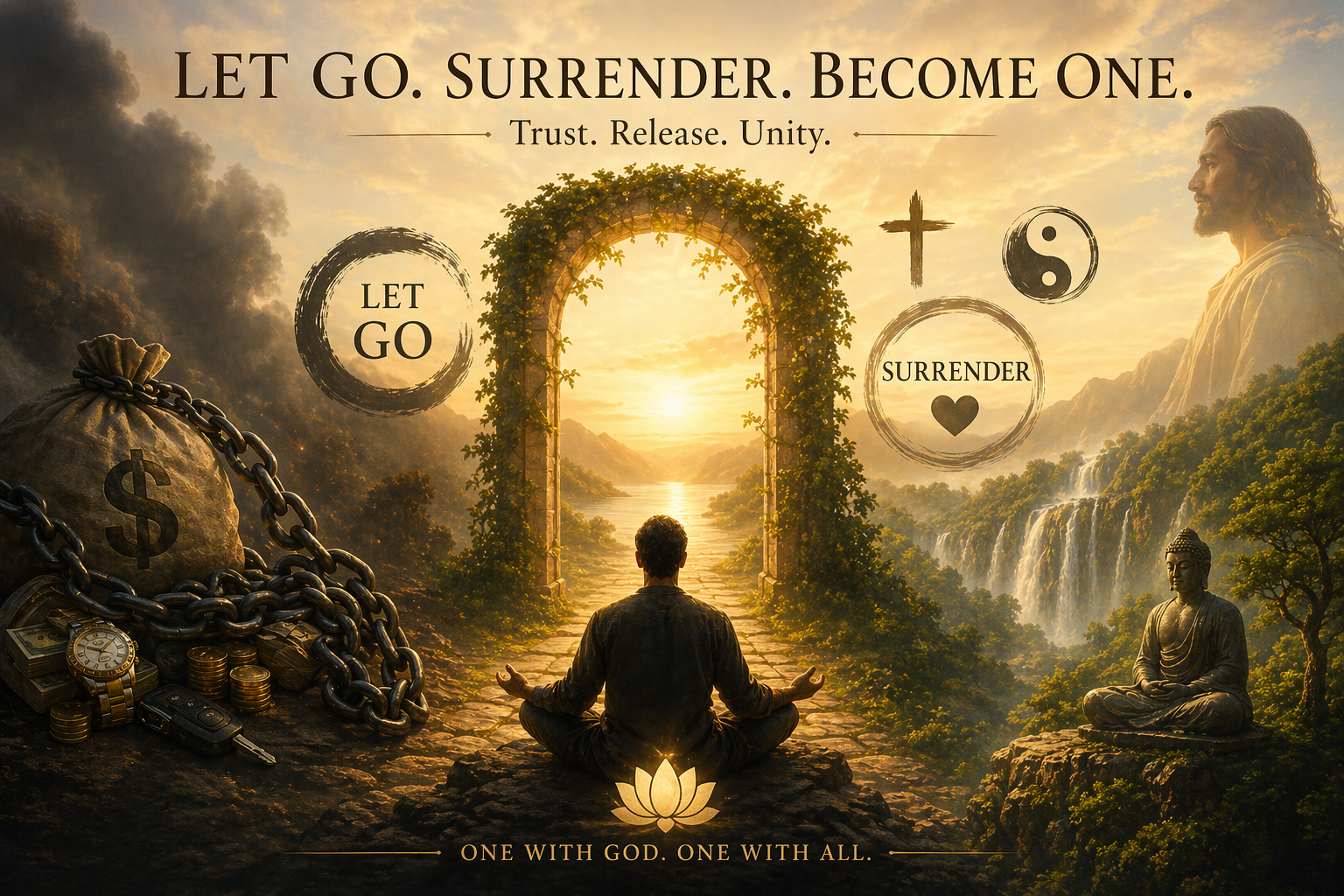
Across the great spiritual traditions — Buddhism, Taoism, and the teachings of Jesus — one principle appears with striking consistency: awakening requires the release of attachment. It is not a peripheral idea. It is central to the path. And yet it is almost entirely absent from the Christianity practiced in most churches today, dismissed — like so many of Jesus’ actual instructions — as Eastern thought or New Age philosophy, despite being woven throughout the very scripture those churches claim to follow.
In Jesus’ teachings specifically, attachment is inseparable from fear and misplaced identity. To be attached is to attempt to secure yourself apart from God — to grip your life, your possessions, your sense of self so tightly that there is no room left for surrender.
“Do not worry about tomorrow…” (Matthew 6)“Whoever loses their life will find it”
Attachment = trying to secure yourself apart from God.
Surrender = trusting and releasing control to God.
“Do not worry about tomorrow” is not a gentle suggestion about stress management. It is a direct instruction to release the ego’s compulsive need for total control. “Whoever loses their life will find it” is not a call to martyrdom. It is a description of what happens when a person is willing to let go of their attachment to ego, body, and identity — and what becomes available on the other side of that release.
Material possessions are the most visible form of attachment Jesus addresses, and money is his most frequent example. The point is not a condemnation of wealth itself. It is an observation about what wealth does to identity. When material possessions become extensions of who you are — when acquiring more of them produces a person’s sense of self rather than simply comfort or security — they become an obstacle. Jesus notes that a poor person may find the path easier not because poverty is virtuous, but because they have less identity wrapped up in what they own. The problem is not owning money. It is when money owns you. Substitute whatever material accumulation functions that way in your own life, and the teaching applies equally.
This also answers a question worth addressing directly: can a person of substantial net worth follow Jesus’ teachings genuinely? Yes — but only with honest self-examination/self-awareness. The question is not what you have. It is what you are attached to. Materialism is not defined by a number in a bank account. It is defined by its grip on you.
The practice, then, is declaration and reorientation. Declare that your possessions are not who you are. Declare that you are a child of the same source as every other human being on this earth — that we are, in the most fundamental sense, one. Declare that what you seek above all else is the experience Jesus called the Kingdom of God within us: the direct, felt realization of oneness with the universe, with humanity, and with God.
“Oneness is the highest goal I seek, achievable only with your help Father”
Oneness with God was not an experience Jesus claimed exclusive access to. It was one he actively wanted others to share. His words on the subject are unambiguous:
“On that day you will realize that I am in my Father, and you are in me, and I am in you.”
“I in them and you in me, that they may become perfectly one…”
“On that day you will realize that I am in my Father, and you are in me, and I am in you.”
These are not declarations of his unique divinity. They are invitations. They describe man’s shared oneness with God that Jesus experienced, taught, and explicitly extended to everyone around him. The longstanding misreading of these passages stems from approaching the text with the assumption that Jesus was claiming to be God himself. He was not. He was pointing toward something available to all of us and telling us, as clearly as language allows, that the door was already open. When Jesus spoke of humanity as children of God, he was not carving out a special identity for himself. He was describing a universal inheritance. Yes, he was clearly guided by the Holy Spirit toward a specific purpose as a teacher, but that did not make him more a son of God than the rest of us. We are all, collectively, children of the same source. He knew it. He lived it. And he spent his entire ministry trying to make sure everyone else knew it too.”
Surrendering consists of trusting and releasing all control to God. Identify what you’re clinging onto, hand it over in your thoughts and prayers (In peace, I release control, let your will be done instead of my own. Guide me on the optimal path).
Surrender, in this context, means more than a posture of humility. It is an active, ongoing practice — the conscious release of control, offered sincerely in prayer:
“In peace, I release my grip. Let your will be done, not mine. Guide me toward what is best.“
But surrender is not only the relinquishing of control. It is also the relinquishing of attachment — to outcomes, to identity, and to the material possessions that have quietly become substitutes for genuine peace. Jesus is direct on this point:
“Take care, and be on your guard against all covetousness, for one’s life does not consist in the abundance of possessions.”
The instruction is not subtle. Identify where accumulation has become compulsion in your own life. Name it honestly. Then begin the work of loosening its grip, because materialism is not simply a financial habit — it is a spiritual red flag, a signal that the ego has found another object to anchor itself to in place of the deeper unity being offered.
What makes this teaching particularly significant is where else it appears. Buddhism identifies attachment and craving as the root of all suffering. Taoism teaches that clinging to possessions and outcomes is the ego’s resistance to the natural flow of existence. These are not competing ideas. They are the same insight, arrived at independently across different traditions and centuries — which is precisely the point. Jesus was not offering an exclusive theological system. He was pointing toward universal truths about the nature of consciousness, the ego, and liberation from it.
This should give any Christian pause before condemning those traditions. To attack Buddhist or Taoist traditions is by definition an attack the very principles Jesus taught. The hostility many Christians direct toward other spiritual paths is not rooted in genuine theological contrast — it is tribalism, plain and simple. It is the ego defending its identity under the banner of faith. And it is among the clearest examples of how thoroughly the institutional church has drifted from the man whose name it carries.
Feel free to subscribe to my new Substack! You’ll also find my latest writings published there if you prefer it over WordPress, along with refreshed and updated versions of some of my earlier work, thoughtfully adapted for the new platform. I’d love to have you join me there!
Alternatively, you can subscribe to my traditional email mailing list below!




Leave a Reply