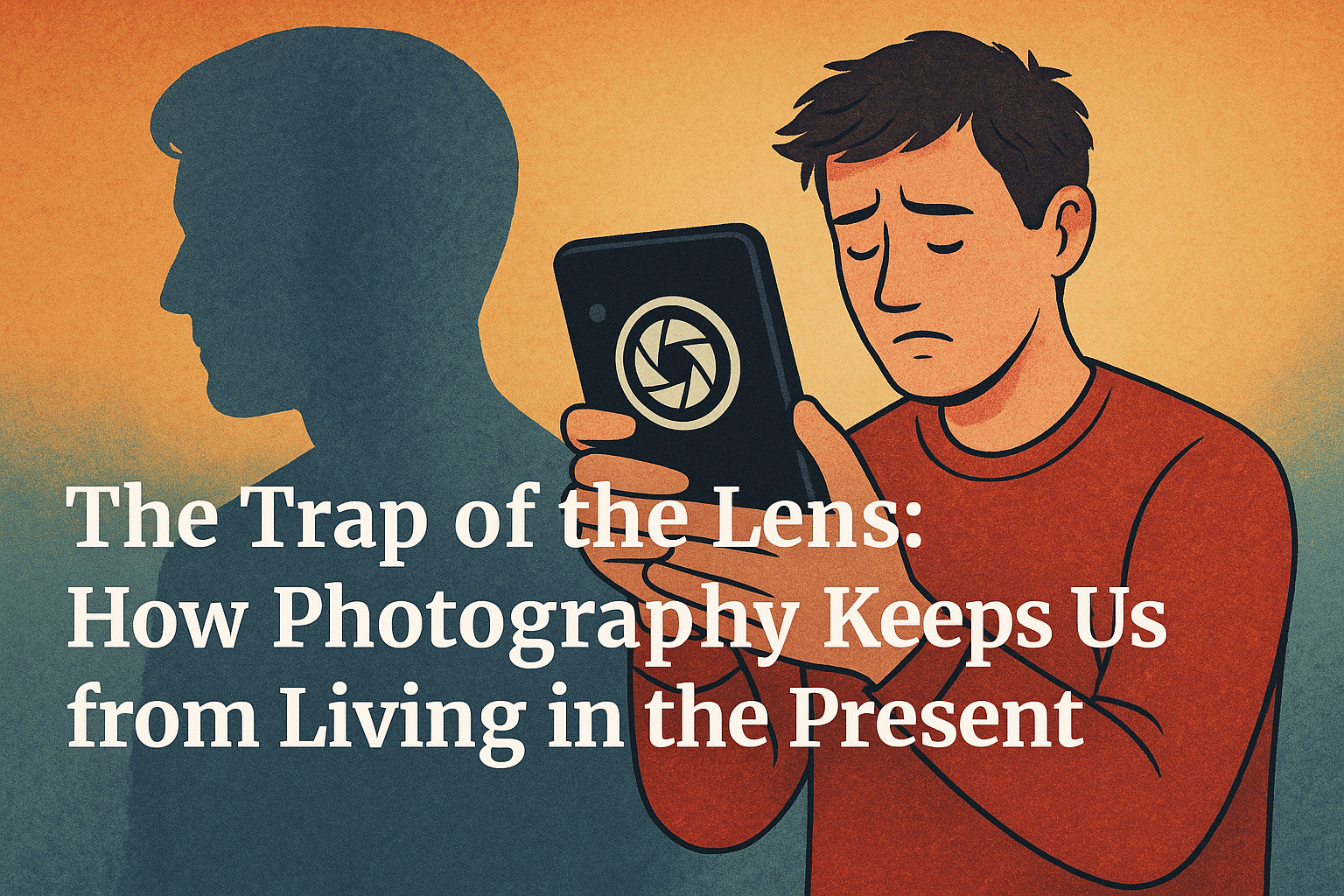
It’s important to understand that constantly dwelling on the past keeps you mentally anchored there—and as a result, you begin to unconsciously recreate the same hardships and struggles in your future. Your thoughts shape your reality, and when those thoughts are fixated on past pain or regret, you end up reliving those experiences in new forms.
As if our own minds weren’t enough to trap us in the past, the ubiquity of photography makes it even harder to move on. Society needs to take this more seriously. With cameras in our pockets and social media platforms built to archive and showcase endless photos, we’re surrounded by constant reminders of who we used to be and what we’ve been through. This creates a feedback loop that makes true healing and forward movement increasingly difficult.
The advice to “stop living in the past” is universally echoed for good reason—it works. But it’s harder than ever to follow in an age where the past is not only remembered but preserved, curated, and broadcasted. While sharing memories might seem harmless, the cumulative effect can be psychologically unhealthy. True growth requires us to focus on where we’re going, not where we’ve been. And sometimes, that means putting the camera down and giving ourselves permission to let go.
There has long been a perception that Native Americans were averse to photography due to a supposed belief that cameras could “steal people’s souls.” While often dismissed as superstition, I would argue this aversion had a deeper, more spiritual foundation—one rooted not in fear of soul theft, but in an understanding of how photography can tether us to the past. For many Native American tribes, whose worldviews were deeply spiritual and centered around living in harmony with the present moment, it’s entirely plausible that their hesitancy reflected a wisdom we’ve largely forgotten: that living in the past obstructs the path to spiritual enlightenment.
No souls were being stolen—but perhaps something equally sacred was being disrupted: the clarity and presence needed to fully inhabit the now. What may have been mistranslated or misunderstood as superstition was likely a profound insight into consciousness and well-being. To walk a spiritual path, one must learn to let go of the past completely. Yet in our modern world, photography makes that increasingly difficult. The constant capturing, curating, and revisiting of moments—both joyful and painful—can trap us in cycles of nostalgia, regret, or longing. Each photo becomes a distraction, pulling us out of the only place where true peace and joy reside: the present moment.
Anyone who has ever flipped through photo albums of “better times” or emotionally charged memories knows how powerful and disruptive these images can be. They’re not just reminders of the past—they’re emotional anchors that prevent us from fully living in the now. And in a world where cameras are literally built into our phones, this challenge has only intensified.
But there are ways to resist. Some have chosen to downgrade to simple phones or disable their cameras entirely. Personally, I’ve taken steps to distance myself from this attachment—I’ve archived all my Instagram photos, deleted images from past relationships, and moved all old photography off my phone so I’m not constantly confronted with them. I still use the camera when necessary, but with intention and restraint.
It’s not about rejecting technology altogether—it’s about reclaiming our presence. Enlightenment doesn’t live in the past, nor in our memories. It lives in the present, and we must protect that space fiercely if we are to grow.
It’s a common and valid complaint that phones—and especially their cameras—keep us from fully experiencing the present moment. I’ll admit with some regret how many times I’ve instinctively raised my phone to record a band I was seeing live, only to realize I was missing the very experience I came to enjoy. These are modern habits that need to be unlearned.
But living in the present isn’t just about letting go of the past—it also requires releasing our grip on the future. The ego constantly pulls us toward control: planning, worrying, anticipating. True presence demands we loosen that grip. We must quiet the ego’s endless urge to dictate what comes next and instead surrender that space to a higher guidance.
Ask the universe—ask the Holy Spirit—for direction. Let go of your anxieties about the future and trust that you will be led where you’re meant to go. This surrender is not passivity; it is a courageous spiritual act. As Jesus taught:
“Therefore do not worry about tomorrow, for tomorrow will worry about itself. Each day has enough trouble of its own.” (Matthew 6:34)
He also taught us to say, “Thy will be done,” a simple but profound invocation to relinquish egoic control and let the divine take the wheel. This isn’t just a metaphor—it’s a real shift in consciousness. And yes, it absolutely works.
When you’ve truly let go of the past and surrendered the future, you finally arrive in the only place where peace, joy, and clarity exist: the present moment. It’s not some mystical destination hidden in faraway scriptures or mountaintop retreats. It’s right here—under your nose this whole time—waiting for you to return.
Many Blessings Your Way! Join my mailing list if you want occasional updates.
I do not spam email boxes and will not try to sell you anything!





Leave a Reply