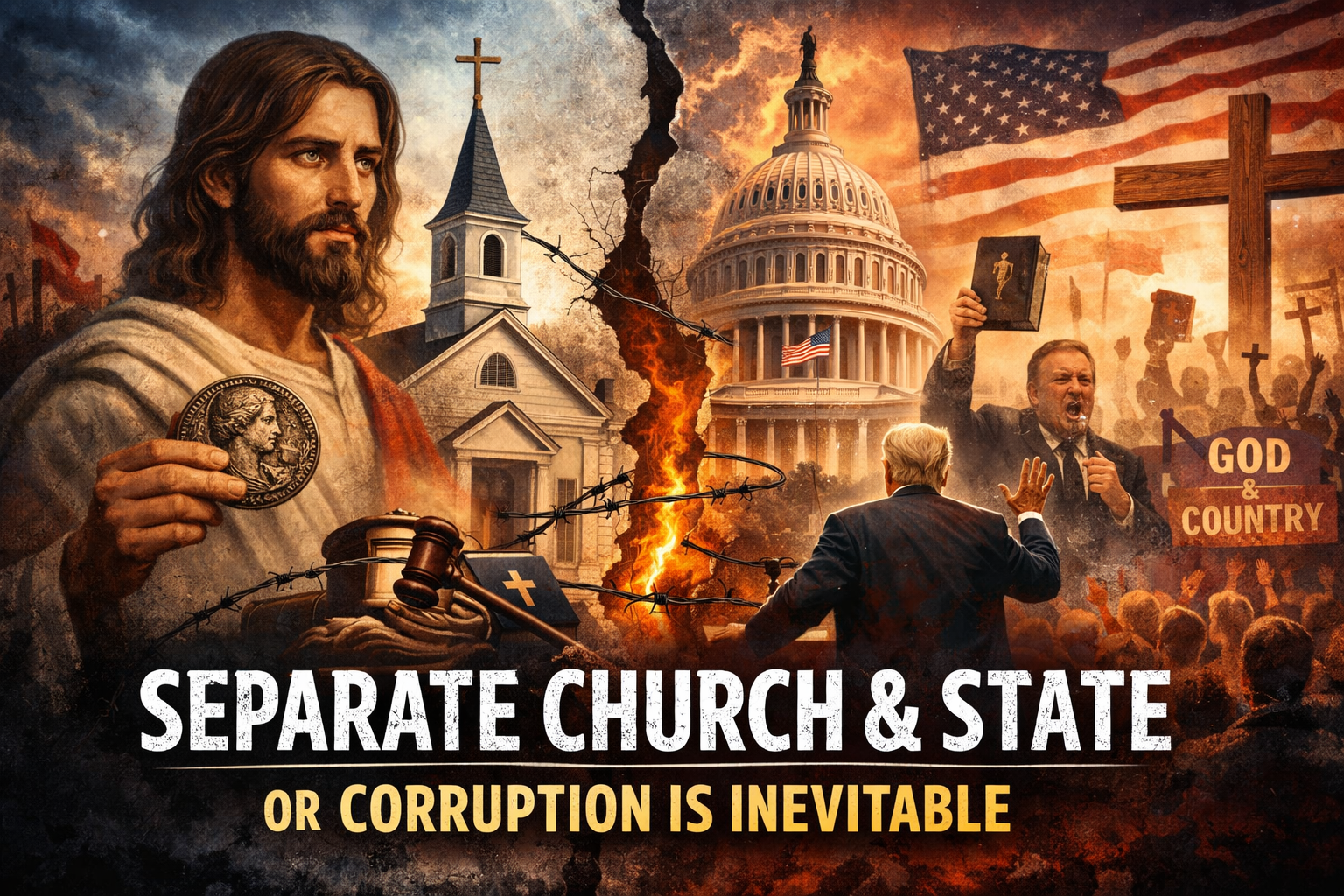
When Jesus said “Render to Caesar the things that are Caesar’s, and to God the things that are God’s,” the surface reading has always been regarding taxation. The deeper meaning was a declaration of principle: keep government and spirituality separate, because fusing them corrupts both. Jesus understood that political power and money occupy the same corrupting territory — and he explicitly placed both outside the boundaries of authentic spiritual life. You don’t need to be a Christian to recognize the wisdom in that. You only need to look at what happens, historically and without exception, when the boundary is ignored.
History is unambiguous on this point. When religious certainty is married to governmental authority, the result is an institution that becomes nearly impossible to question, criticize, or hold accountable. Sacred endorsement insulates power from scrutiny. Democratic accountability erodes. And the spiritual tradition being invoked gets contaminated by the very forces it was meant to transcend.
What is happening in contemporary American Christianity represents an accelerating version of exactly this pattern. Christian theology, biblical language, and religious symbolism are now routinely deployed in government settings — not as personal expressions of faith, but as implied divine sanction for public policy. The message, often stated explicitly, is that certain elected officials are carrying out God’s will. For the most devout believers, that framing places those officials and their actions beyond legitimate challenge. Opposing them risks not just political disagreement but eternal consequence.
Donald Trump has cultivated this dynamic deliberately, positioning himself as a champion of Christian values while famously struggling to name a favorite biblical verse when asked. The performance has been effective regardless, because for a significant portion of the Christian nationalist base, the signal matters more than the substance. Meanwhile, figures like Pete Hegseth have brought religious voices directly into the machinery of government — including a pastor, Doug Wilson, invited to speak at the Pentagon, whose views include a defense of slavery on the grounds that the Bible does not explicitly prohibit it. That this position violates the most fundamental instruction Jesus ever gave — “do unto others as you would have them do unto you” — appears not to have been a disqualifying consideration.
The Republican Party’s persistent and unapologetic invocation of God to justify its political agenda has produced a base that largely equates the party’s platform with divine will. For many within that base, a single issue — abortion — functions as the moral master key. Once that box is checked, virtually any other policy or behavior is rationalized away, because the singular win is treated as sufficient justification for everything that follows. Cruelty, dishonesty, nationalism, and the celebration of military aggression in church settings all get absorbed into the framework of righteous governance. Pastors with large congregations openly praise political leaders for military actions that Jesus’ teachings categorically oppose — and those congregations receive the message that all of it is spiritually acceptable, as long as the declaration of belief has been made and the tithing form has been signed.
This is Christian nationalism: the most toxic possible expression of Jesus’ teachings, and in many respects their direct inversion. It wraps superiority, separatism, and violence in the language of the man who preached universal love, humility, and the dissolution of exactly those impulses. It leverages spiritual devotion as a political instrument — which is precisely the corruption Jesus warned against when he drew the line between Caesar and God.
The politicians exploiting religious sentiment for electoral power, and the religious institutions being corrupted by proximity to that power, are two sides of the same problem Jesus identified two thousand years ago. He solved it with a single sentence. The tragedy is not that the solution was obscure. It’s that it was ignored.
The impulse to force others into one’s religion via the state is, at its root, an ego problem — a demand for conformity that has nothing to do with genuine faith and everything to do with identity preservation. Jesus never instructed his followers to coerce, legislate, or pressure anyone into belief. That instinct belongs to the ego, not the spirit.
Authentic spiritual teaching spreads the only way it should: by example. When a path genuinely transforms a person — when it produces visible peace, compassion, and freedom — others are drawn to it naturally. No pressure required. No prayers extracted from unwilling lips, repeated without soul or sincerity, meaning nothing to anyone. That is not conversion. That is performance.
What ultimately undermines mainstream Christianity’s reach is not the secularism of the outside world — it is the contradiction within. When a faith openly endorses policies and postures that betray the most basic teachings of the man it claims to follow, the message collapses under the weight of its own inconsistency. If the goal is to reflect the teachings of Jesus, the path forward is simple, if not easy: embody them. The rest will follow on its own.





Leave a Reply