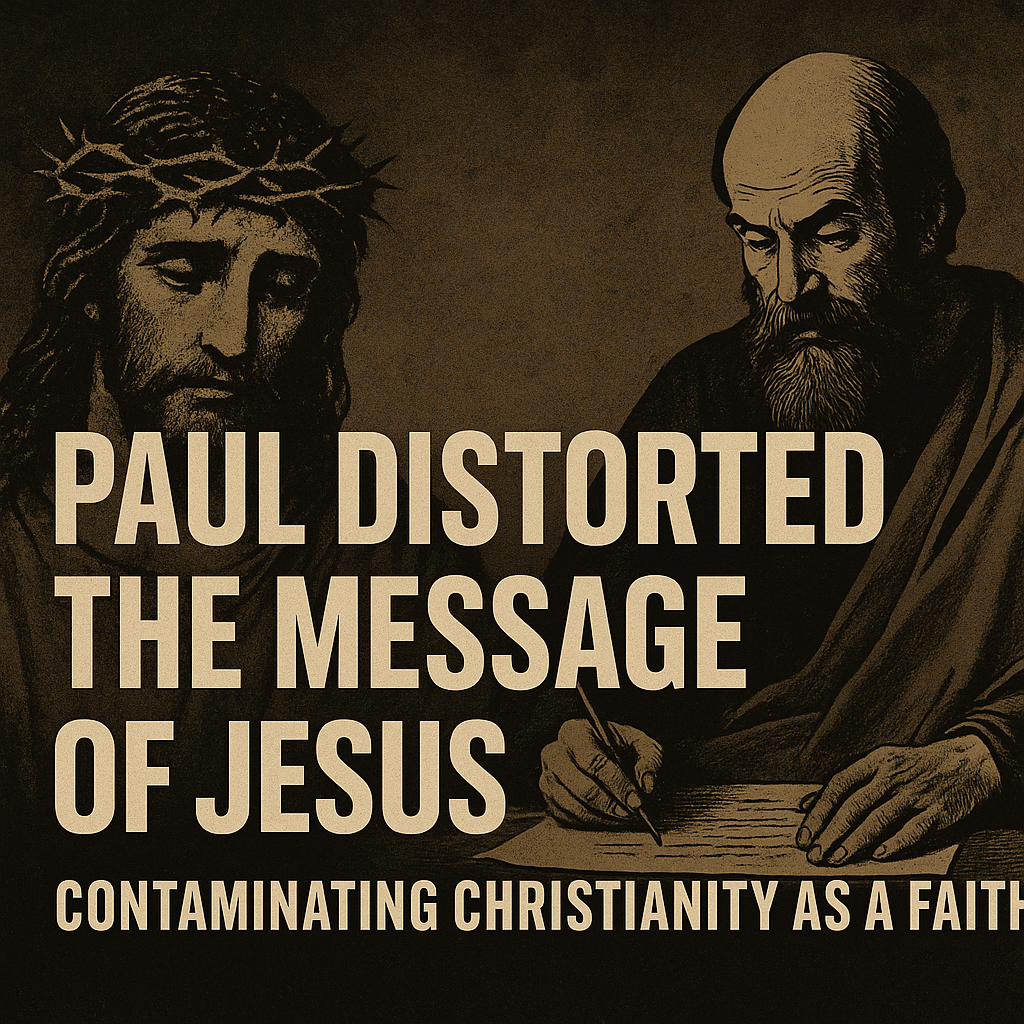
One of the most consequential and least examined facts in Christian history is this: the man responsible for reshaping much of Christian theology never met Jesus. Not once. Paul was not a disciple. He was not present for the ministry, the teachings, or the crucifixion. He arrived years after Jesus’ death, claiming a private vision had granted him the authority to redefine the faith from the ground up.
Christians are expected to take that claim at face value — to accept that a vision experienced by a man who never knew Jesus personally somehow carried sufficient authority to redirect the entire trajectory of his message. And redirect it Paul did, in ways that proved catastrophic for the integrity of what Jesus actually taught.
The most damaging of Paul’s contributions was the doctrine that simply declaring belief in Jesus was sufficient for salvation. Jesus never taught this. The concept of passive belief as a spiritual shortcut is nowhere in the Gospels. What Jesus taught was a demanding path of inner transformation — ego dissolution, active love, radical forgiveness, and the pursuit of genuine oneness with God and humanity. Paul’s framework replaced all of that with a change of tribal identity. No real spiritual shift required. Just the declaration.
This explains something that confuses many observers of modern Christianity: why so many people who claim to be saved continue living in ways that directly contradict everything Jesus stood for. The answer is that, under Paul’s framework, no actual transformation was ever necessary. Salvation became a label, not a lived reality.
In that sense, Paul’s writings arguably did more lasting damage to Jesus’ message than the crucifixion itself. The cross silenced Jesus physically. Paul’s epistles quietly dismantled what he taught while wearing his name as a banner. One was a violent act of suppression. The other was a slow and sophisticated rewriting — and it worked far more effectively over the long term.
The Roman Empire later compounded the problem by adopting Christianity as a state religion, repackaging Jesus’ image to serve the project of empire. That particular contamination deserves its own examination. But the groundwork for institutional distortion was already laid long before Rome got involved.
What remains difficult to explain is how Paul’s letters ended up canonized alongside the Gospels in the same New Testament — treated as equivalent in authority to the words of a man Paul never met and, in critical ways, directly contradicted. That question deserves far more scrutiny than mainstream Christianity has ever been willing to give it.
Paul’s Teachings versus Jesus’ Teachings
Salvation (Perhaps the most important change from Jesus’ teachings)
Jesus taught that right action, love, and forgiveness is required.
Paul taught that faith in Jesus alone is required (Romans 3:28, Galatians 2:16, Ephesians 2:8–9, Philippians 3:8–9)
Sin:
Jesus taught that people are lost, not born damned (Luke 19:10, Luke 15, Mark 2:17, John 9:1–3, Mark 10:14)
Paul taught it was inherited from Adam (Romans 5:12, Romans 5:18–19, Romans 5:14, 1 Corinthians 15:21–22)
Resurrection (Doctrine changes/additions)
Paul taught Jesus’ literal bodily resurrection was a requirement for “salvation” (1 Corinthians 15:12–14, 1 Corinthians 15:17, 1 Corinthians 15:42), Romans 10:9) despite his followers being able to achieve this without the death of Jesus or his resurrection.
Jesus was less focused on Paul’s dogmas and more so on teaching how to experience the infinite through transcendence of one’s ego and the kingdom of God within for that “salvation”. In Jesus’ teachings and ministry, resurrection was not a pre-requisite for the spiritual enlightenment he was teaching his followers to achieve… The complete opposite of how Paul was reframing everything. Jesus dying did not automatically save everyone, it required following the teachings of Jesus.
Church:
Paul promoted organized gatherings/churches with political structures/components within communities. (1 Corinthians 1:2, Philippians 1:1), 1 Timothy 3:1–13, 1 Corinthians 5:1–5, 1 Corinthians 6:1–6)
Jesus never formally established any official “church” and this was a deliberate choice. He knew that a structured institution were not necessary to spark spiritual awakening and that powerful churches were ripe for corruption. Instead, He taught people how to experience this transformation while walking among them in everyday life, not from within a formal religious setting. His subversive ministry was a threat to formal religious institutional that taught that never taught churches were necessary for for salvation. Jesus was teaching spiritual awakening/salvation was available within, without the requirement of any formal church intermediary. Simply by following his instructions to find heaven within, and now. His takedown of churches was consistent with his decision to not formally organize a formal church
Gender/Sexuality:
Paul preferred patriarchal order, celibacy preferred. He upheld the notion of women being lower class citizens (1 Corinthians 11:3, Ephesians 5:22–24, 1 Corinthians 14:34–35, 1 Timothy 2:11–12, 1 Corinthians 7:7–8, 1 Corinthians 7:32–34), Galatians 3:28)
Jesus broke cultural norms with women often, frequently treating them as equals when cultural norms went against this.
Government:
Paul advocated submitting to ruling authorities (Romans 13:1, Romans 13:2, Romans 13:3–4, Romans 13:6–7, Titus 3:1)
Jesus challenged unjust authority his entire life, not only the state but religious power structures as well.
Spiritual Law/Commandments:
Paul argued we are free from spiritual law and guidelines. Not exactly helpful in helping people trigger enlightenment. (Galatians 3:24–25, Galatians 5:1, Galatians 5:18, Romans 6:14, Romans 7:4–6, Romans 10:4, 2 Corinthians 3:6, Colossians 2:13–14)
Jesus upheld and expanded spiritual guidelines his entire life
Why Christianity Stopped Working — And What It Would Take to Fix It
Christianity, as it exists today, is objectively a mess. That’s not an attack — it’s a diagnosis. And the only honest path toward restoring its power is a full return to what Jesus actually taught. His essential message, stripped of two thousand years of institutional accumulation, could fit on a pamphlet. Christians don’t need the entire New Testament, let alone the Old Testament, to understand or live by it.
The drift has been so severe, and so prolonged, that modern organized Christianity now functions almost as a distortion of its source — bordering, in its current form, on disrespect for what Jesus originally intended. More practically, it has stopped working. For a growing number of people, following mainstream Christianity as it is currently taught produces no genuine spiritual transformation. The path, as packaged and delivered, is practically designed to make you fail.
The contrast with Buddhism makes this impossible to ignore. Buddhism’s core principles overlap substantially with what Jesus taught — the two traditions are, at their instructional heart, pointing toward the same destination. Yet Buddhism consistently produces genuine spiritual awakenings at a far higher rate than Christianity does. Two paths with nearly identical directions are yielding completely different results. One reliably helps people awaken to their oneness with the universe. The other leaves many of its followers bewildered at the very concept. That disparity should trouble serious Christians. It’s what first troubled the author of these pages.
The universe, for its part, is indifferent to which religious label a person wears. What matters is whether someone is walking a genuine path toward awakening. There is no spiritual tollbooth checking religious affiliation before granting access to higher consciousness. If Jesus’ teachings were faithfully practiced, Christians would be standing alongside Buddhists, recognizing their shared foundations in compassion, humility, and selflessness — not treating them as opponents or, as is disturbingly common, labeling them satanic.
The distortion of heaven has been one of the most consequential obstacles of all. When Jesus spoke of entering the Kingdom of God within, he was not describing a physical destination reached after death. He was describing a transition — from the lower egoic mind into a higher state of consciousness, available now, from within. Recasting that as a post-death reward effectively told people they possessed a winning lottery ticket they could only cash in once they were dead. That single inversion has kept generations of Christians from reaching for an experience that was always theirs to claim.
That experience — the euphoric awakening Jesus described — has been documented across virtually every spiritual culture in human history. Nirvana, Enlightenment, Kundalini Awakening, Satori: different names, different traditions, all pointing toward the same thing. An awakening to our true nature and our oneness with the universe, as the illusion of separation between ourselves and everything else begins to dissolve. The tribalism embedded in modern Christianity wants to treat this as a religiously exclusive experience. It isn’t. And claiming otherwise contradicts everything Jesus taught.
The heavy use of metaphor and allegory in Jesus’ teachings has added another layer of difficulty. Rather than engaging with the deeper meaning his figurative language was designed to carry, many readers flatten it into literal promises of afterlife rewards — and the transformative instruction underneath gets lost entirely.
Personally, Christianity was abandoned not out of hostility toward Jesus, but because it simply wasn’t working spiritually — even though it clearly contained core truths. The problem was never him. The problem was that his teachings had been corrupted so thoroughly, and so long ago, that the path stopped leading anywhere real. That experience is far from unique.
Today, no religious label applies. Being a spiritual person — one with all of our Father’s children, exactly as Jesus taught — is sufficient. No institution owns these teachings. They belong to no denomination, no tradition, no tribe. They are available to anyone willing to walk the path they describe, whatever name they choose to walk it under.
Feel free to subscribe to my new Substack! You’ll also find my latest writings published there if you prefer it over WordPress, along with refreshed and updated versions of some of my earlier work, thoughtfully adapted for the new platform. I’d love to have you join me there!
Alternatively, you can subscribe to my traditional email mailing list below! No marketing or selling of emails will occur, it’s just for updates.
Many Blessings Your Way! I do not spam email boxes and will not try to sell you anything!





Leave a Reply