
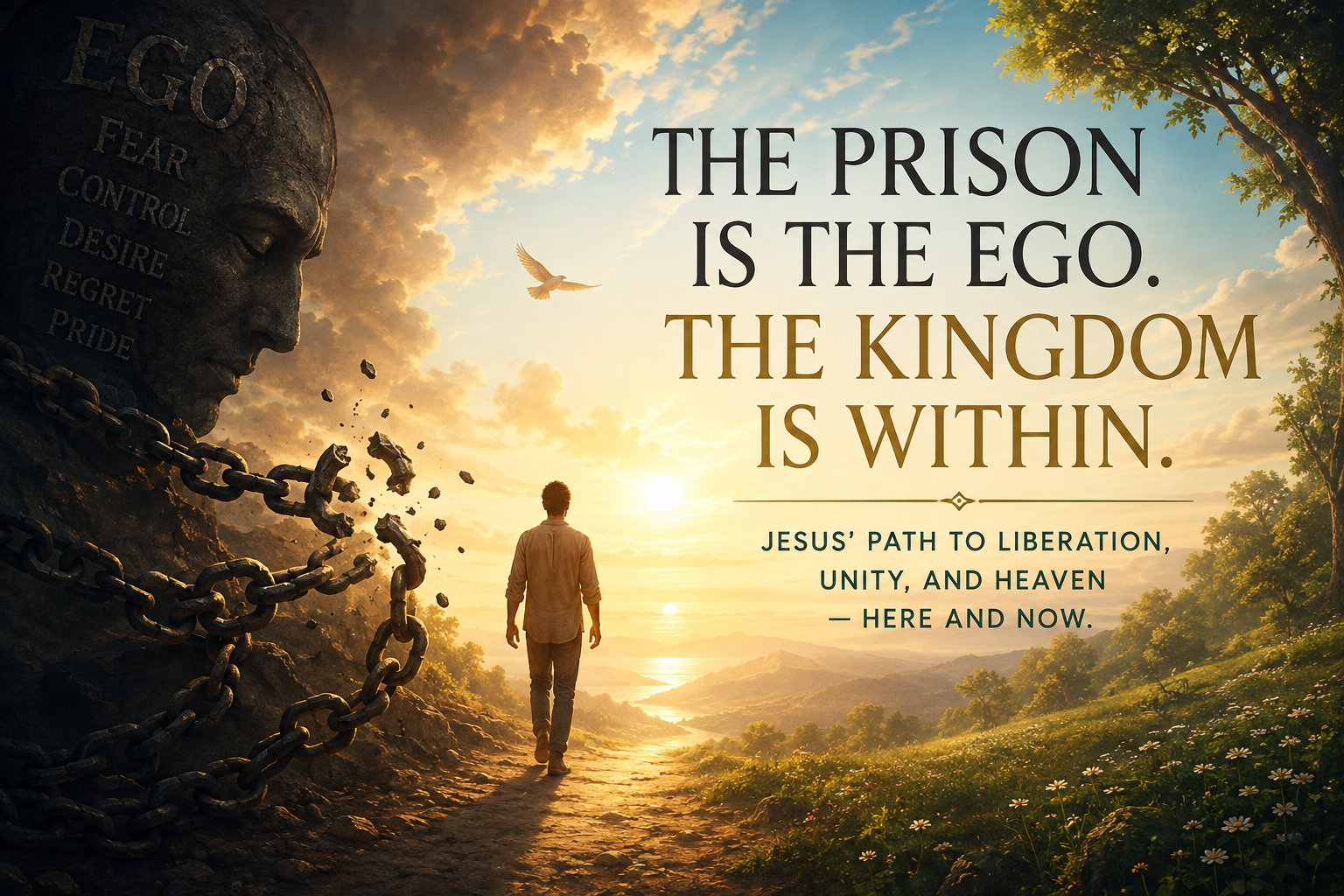
Any modern Christian sermon that promises happiness and paradise exclusively after death is not preparing its congregation for eternal life. It is distracting them from it. The reward being dangled in the distant future is available right now — an inner state of bliss that Jesus consistently pointed toward as a present reality, not a posthumous one. Deferring it to the afterlife is one of the most consequential distortions of his message, and its damage is measurable: the vast majority of Christians sitting in mainstream churches today have never reported a firsthand experience of ego transcendence. That absence is not a coincidence. It is the predictable result of a tradition that stopped teaching the path Jesus actually described.
“Whoever wants to be my disciple must deny themselves and take up their cross and follow me. (Matthew 16:24)
By “denying themselves” Jesus is saying to suppress and silence our egos to be his follower. However it is far too common in mainstream Christianity when discussing this verse that the term ego is never brought up once despite this being exactly what Jesus was referring to.
“Whoever loses his life for my sake will find it.” (Matthew 16:25).
(Again, Jesus is referring to letting go of our human ego to reveal their higher Self, here but literalists will walk away thinking Jesus wants his followers to literally kill themselves)
“Deny yourself” – Matthew 16:24 (also Mark 8:34, Luke 9:23)
Again, Jesus is referring to letting go of the identity and ego we’ve spent our life cultivating.
“You must be born again” – John 3:3
The concept of being “born again” is best understood as the result of transcending the human ego. Those who undergo a genuine spiritual awakening often describe it as if they are experiencing life and reality for the very first time, hence the metaphor of being born again. In contrast, mainstream Christianity has largely reduced being born again to a ritual or declaration: being baptized, signing a card, or verbally affirming Jesus as one’s savior. If you ask most self-described “born again” Christians about their experience, they rarely speak of the profound, transformative state of ego dissolution. Instead, their accounts often focus on outward rituals, such as baptism, communion, or taking part in bread and wine, rather than the inner rebirth of consciousnesses and spirit that Jesus was pointing toward.
“Not my will, but yours be done” – Luke 22:42
Your ego spends your entire life trying to control every aspect of it. Transcending the ego requires letting go of your constant need for control and instead surrendering to the greater will of God and the universe, hence the prayer, “Thy will be done.” Any Christian church that fails to emphasize this, or does not teach its members to resist the ego’s insistence on control, is missing a central element of what Jesus was truly teaching. I recommend prayers and meditations that reinforces in your consciousness and your unity with the universe, our father and all other humans, your voluntary decision to release all control and surrender. Speaking as someone who attended a lot of church in life, I never saw any pastors and ministers encouraging members to ease up and let go of all control and to let our father and holy spirit take the wheel instead. This is a critical teaching, and is why it was an important declaration in the lord’s prayer.
Jesus’ teachings of transcendence of the human ego constitutes the pathway to experiencing “heaven” in the present moment, a theme that resonates strongly with Eastern spiritual traditions such as Buddhism and Hinduism. Despite these parallels, many Christian pastors and preachers insist on drawing rigid distinctions between Christianity and Eastern spirituality, thereby reinforcing a dichotomous “us versus them” framework. Within such a framework, Christians are frequently taught that their tradition shares no substantive common ground with Buddhists, Hindus, or adherents of other faiths.
This posture of separation can best be understood as a manifestation of the ego itself: the ego’s inclination to construct hierarchies, to claim superiority, and to preserve tribal boundaries rather than embrace unity and oneness. A perfect recent example arises from a pastor’s account of missionary work in Asia. In dialogue with a Buddhist monk, the monk perceptively noted that Christianity and Buddhism actually share significant commonalities, though they are expressed through different terminologies. Rather than acknowledging this point of convergence, the pastor retorted, “No! We have Jesus and he died for our sins!” Such a response exemplifies an ego-driven insistence on uniqueness and exclusivity, even at the expense of genuine interreligious understanding and embracing our oneness.
Thus, what could have been a profound moment of recognizing shared spiritual insight was forfeited. The opportunity for cultivating unity was undermined by the ego’s drive to maintain separation and superiority, highlighting how the very obstacle both Jesus and Eastern traditions caution against continues to shape religious discourse.
The similarities between what Jesus taught and eastern spirituality teaches are significantly more than Christians would like to admit. This is mostly chalked up to the fact that our human egos insist on drawing borders between ourselves and others rather than seeing our similarities and oneness. Tribalism continues to be the ego’s curse on humanity and it should be resisted any time it rears its ugly head.
The truth is simple: The euphoric experience of Infinity exists in the present moment, once properly channeled and attained. It is a cosmic and profound experience where you feel oneness with the universe, god and humanity. (aka born again). There should be many testimonials relating and recounting that exact experience in many Christian churches but that is not happening. The relative absence of these accounts in many churches underscores the extent to which the core of Jesus’ teachings has been obscured or diminished within mainstream Christianity. Unfortunately, one needs to start going into the lesser known denominations of Christianity that would be arrogantly dismissed as ‘mystical’ or ‘new age’ by your favorite local teacher just for correctly teaching the very ideas that Jesus himself was teaching. If you want to see your local pastor wince, use a term like the ‘present moment’, which they will almost always see as eastern or mystical. This is despite Jesus always advocating to live in the present moment when he said to leave the past in the past and to leave the future in God’s hands:
“No one who puts a hand to the plow and looks back is fit for the kingdom of God”
“Do not worry about tomorrow” & “Do not worry about your life”
Much to the dismay of your local pastor who insists Christianity has nothing in common with Eastern spirituality, Jesus is in fact expressing ideas that deeply resonate with those traditions: to live fully in the present moment, to voluntarily let go of control even when the ego resists. The true spiritual task is to overcome that resistance.
These are not vague spiritual suggestions. Present-moment awareness — the very practice that forms the foundation of Buddhist mindfulness — is embedded in the Gospels. Yet mention wanting to live in the present moment in many mainstream Christian circles and watch the discomfort register in real time. The concept gets dismissed as Eastern, New Age, or mystical, despite being something Jesus taught explicitly.
The pedantry about terminology — the insistence that valid spiritual teaching must use only the specific vocabulary found in the King James Bible — reveals the tribalism underneath. These gatekeepers would rather defend the exclusive ownership of Jesus’ teachings than acknowledge the undeniable overlap between what he taught and what other traditions have practiced for centuries. The obsession with protecting the label takes priority over absorbing the content.
A significant portion of the blame for this drift belongs to Paul — a man who never met Jesus, whose writings fundamentally reshaped the faith into something Jesus would be unlikely to recognize. But the ego’s need for tribal supremacy did the rest. The result is a mainstream Christianity that dismisses as foreign the very practices that would bring it closest to what its founder actually taught.
If you genuinely want something that resembles Jesus’ original path, you will often need to look in exactly the places your local pastor would dismiss. The traditions have been labeled Christian Mysticism, Esoteric Christianity, Christian Nonduality, Eastern Spirituality are frequently the ones keeping the actual instruction alive — while the loudest voices in mainstream Christianity guard the door to a room they stopped entering long ago, purely for power and control. The unfortunate irony is that the teachings that are closest to what Jesus taught are stuck in the periphery while the mainstream routes these seekers on a misdirected path.
Much of the harm towards Jesus’ teachings also came from Paul, an author in the new testament who never even met Jesus, but much of his writings are the reason there was a metamorphosis from Jesus’ original teachings into the Christianity we have today and does not resemble Christianity as it was during the course of Jesus’ life.
In Short,
Jesus’ core focus: love, mercy, the Kingdom of God, forgiveness, caring for the marginalized, letting go of ego and possessions.
Paul’s focus: Faith in Christ’s death and resurrection as the path to salvation, overshadowing Jesus’ actual ethical instructions.
but that’s a topic for another day.
Many Blessings Your Way! Join my mailing list if you want occasional updates.
I do not spam email boxes and will not try to sell you anything!



Leave a Reply