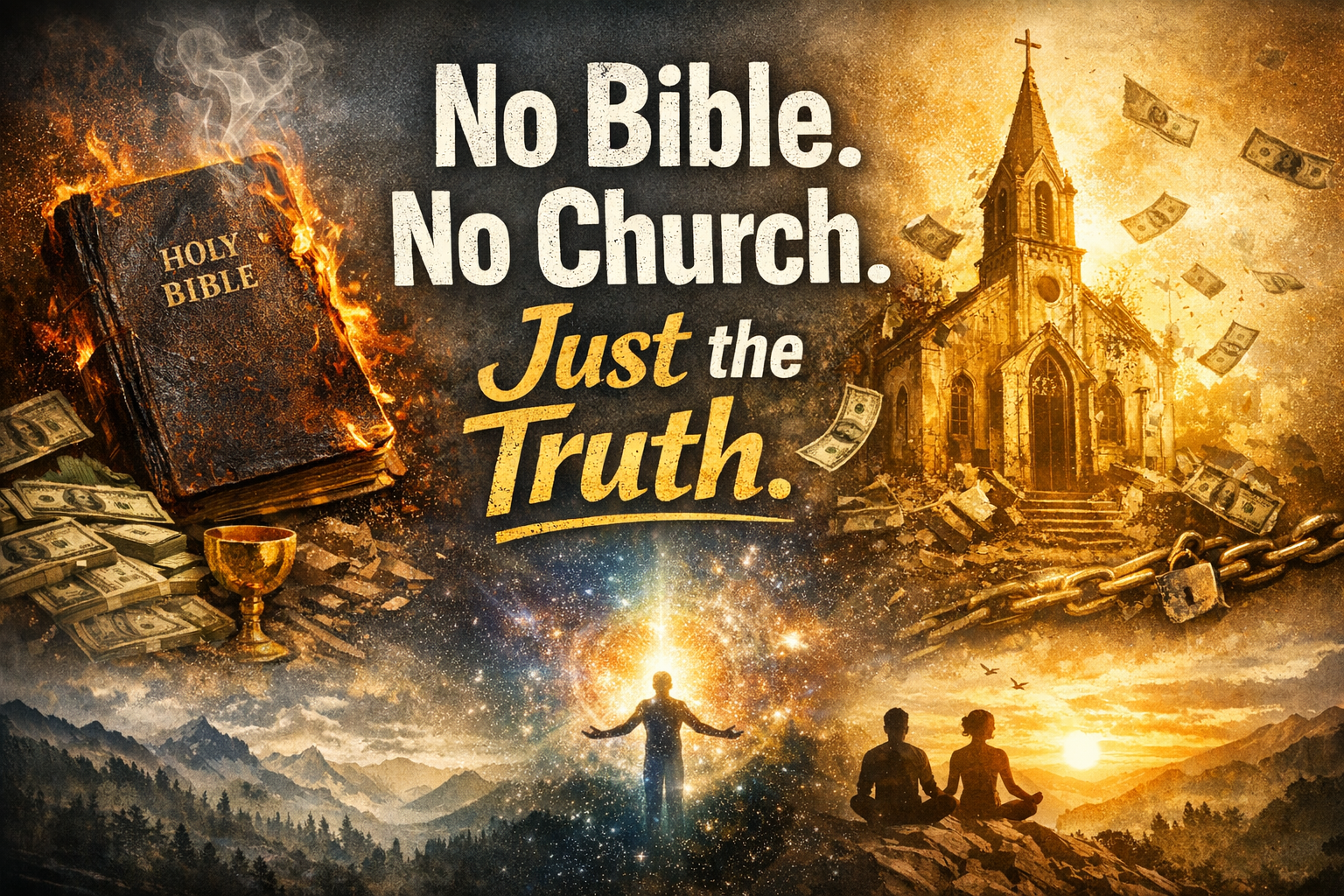
The Church Built on His Grave: Why the Religion Named After Jesus Betrays Everything He Taught
Jesus was killed for being a subversive threat to the religious power establishment of his day. What replaced that establishment after his death was not liberation — it was the same machinery of control, rebuilt from scratch, with his name stamped across the front.
This is the central tragedy of Christianity, and it begins almost immediately after his death. You can see the corruption taking root inside the biblical text itself.
Jesus taught something profoundly threatening to institutional power: that the kingdom of God is accessible within you, right now, without any intermediary. No church. No priest. No tithe. No toll. Human beings already carry a direct connection to what people variously call God, Spirit, or Source — and the moment people truly understand that, the authority of every religious institution evaporates. That was precisely the point. Jesus was transferring power away from religious gatekeepers and handing it back to the individual. The people who murdered him understood the threat clearly. What followed was a reconstruction of the very power structures he dismantled, dressed in his own language.
The formal church was never primarily a spiritual institution. It was a control mechanism — and its most potent tool was positioning itself as the authority on who enters heaven. The power that comes from owning that narrative can’t be overstated. It produces fear, obedience, and financial dependency in those who believe it — which is precisely why Jesus repeatedly instructed his followers to release fear entirely and resist religious power structures. Those instructions didn’t survive the institutions that claimed to preserve them.
The result is the New Testament as we have it: a document that mixes genuine teachings with layers of distortion so thoroughly that it becomes an unreliable foundation for anyone sincerely trying to reach the state of awakening Jesus described. The core problem isn’t that his teachings don’t work — they do, and demonstrably so. The problem is that they’ve been buried under centuries of contradictions, metaphors mistaken for literal truth, and verses that can be cherry-picked to justify virtually any authoritarian or hateful position someone wants to advance.
As a moral compass, the Bible repeatedly fails. It contains endorsements of cruelty, violence, and conduct that is plainly unethical by any serious standard. Because it has been framed as divine and literal rather than as flawed human history, those passages don’t get treated with appropriate skepticism — they get treated as sacred commandment. At most, the Bible belongs in the category of historical artifact: a record of how Judeo-Christianity evolved and how humanity arrived where it did. It should never serve as the unchallenged foundation for spirituality, ethics, or human flourishing.
None of this means the path is lost. It means we need to become ruthless minimalists about what we actually carry forward.
The actual teachings of Jesus — stripped of the institutional wrapping — are not complicated. They could fit on a single page. They require no church, no clergy, and no library of ancient texts to be effective. And those teachings align so precisely with the core insights of Buddhism and Taoism that treating those traditions as opposition, as many Christians are conditioned to do, is itself a rejection of what Jesus taught. The borders drawn between these paths are tribal inventions. The teachings themselves point to the same destination.
Much of the resistance to letting go of biblical tradition comes from fear — fear of hell, fear of disobedience, fear of releasing the familiar. But holding onto archaic, ineffective frameworks out of fear is not spirituality. It is psychological captivity.
The path to the awakening Jesus pointed toward is not locked behind any institution, any text, or any authority figure. It is available now, through practices that cultures across history have discovered independently and described in nearly identical terms. The trigger is already within you. It becomes accessible the moment you are genuinely willing to pursue it.
No Bible required. No church required. Just the willingness to let go of everything that was built to keep you dependent — and return to what was always yours.
So for those keeping track:
- Disassociate from All Religions As Religious Tribes Are No Longer Necessary
As documented here heavily on the site, religion divides people into competing groups, when the entire point is unity. Recognizing that unity is one of the first steps toward real spiritual awakening. True spirituality and oneness is achieved without religion.
2) Abandon all bibles
Only reference the primary teachings of Jesus and succinct instructions on how to trigger spiritual awakening. Carrying around textbook size hardcovers nobody reads helps no one. We already know how to awaken to our oneness with the universe within all of us. The trick is following those directions, not the myriad of misdirections from his teachings clearly visible in the bible.
3) Abandon all churches
They create a false power structure between human beings and the Source, and they repeatedly become breeding grounds for greed, corruption, power and control. They also keep pushing the lie that “heaven” can only be accessed through them, when the truth is the exact opposite. Jesus not only disproved that ‘heaven’ was some post-mortem reward, but also that churches were not necessary to achieve a spiritual awakening to this truth, hence his death.
Anyone who takes time to investigate the damage inflicted by the entire field of prosperity gospel, or the net worth of many churches and ministers, will quickly understand what I mean.
None of these institutions are necessary to live what Jesus taught. The cleanest way to remove the corruption is a complete “power wash” of the religion until only what’s essential remains: the teachings that work, and that align with the most universal spiritual truths incidentally found across multiple traditions.
Anyone who researches the damage of the prosperity gospel—or the net worth of many churches and ministers—will quickly understand what I mean.
None of these institutions are necessary to live what Jesus taught. The cleanest way to remove the corruption is a complete “power wash” of the religion until only what’s essential remains: the minimal teachings that are necessary, that actually work, and that align with the most universal spiritual truths found across traditions.



Leave a Reply