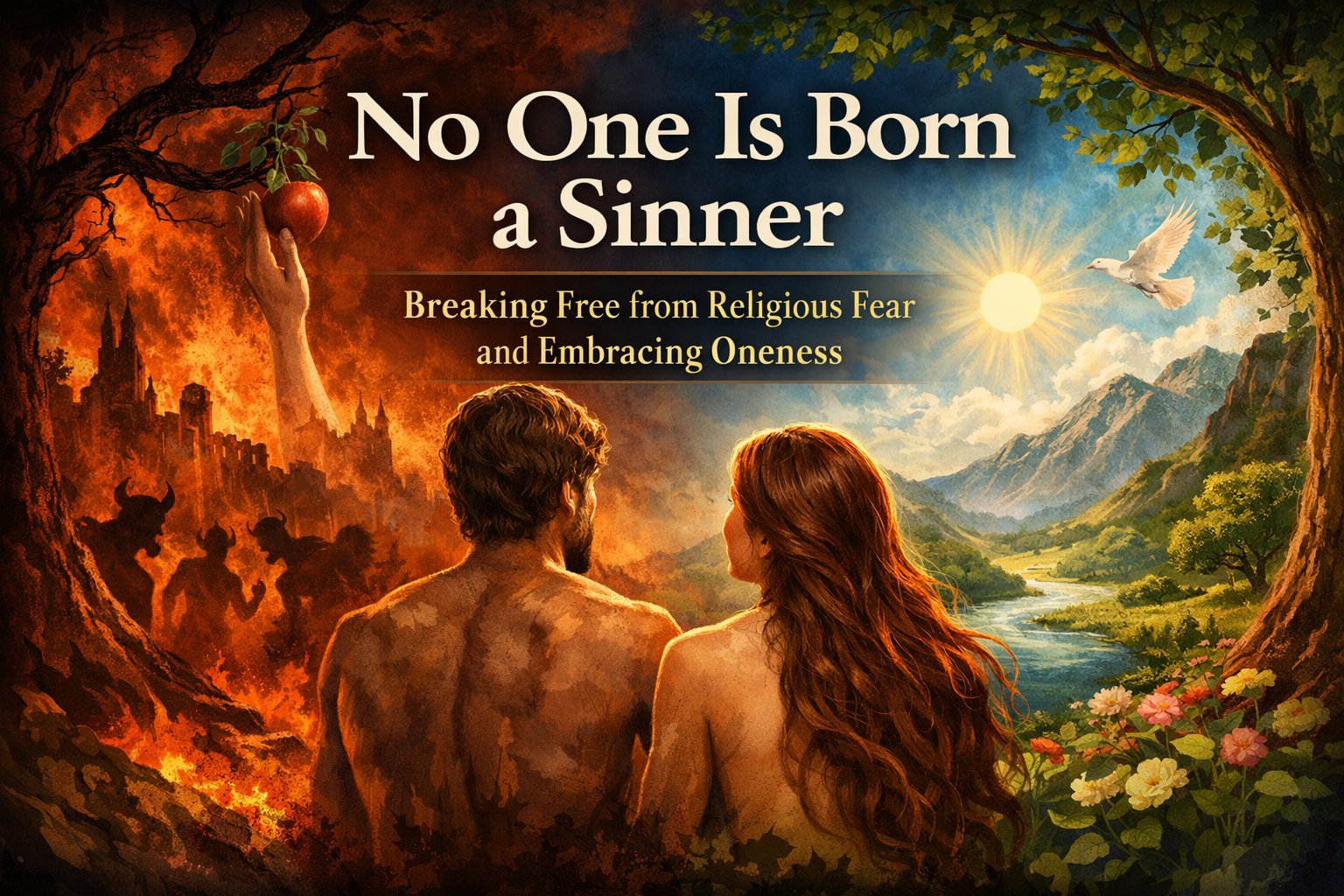
The “born a sinner” narrative has endured for centuries — but it was never meant to be taken literally. It was a story, and like all stories written for a specific audience at a specific moment in history, it deserves to be read in context.
Early Judeo-Christian religion relied heavily on fear as a tool. When you claim the literal authority of God, you gain an unmatched ability to reinforce whatever rules or ideas you want people to accept. And the audiences receiving these teachings lacked education, psychological insight, or any understanding of how the human mind actually works. Complex inner concepts had to be delivered in exaggerated, fantastical terms — much like the frightening fairy tales of Hansel and Gretel, designed to be exciting and memorable enough to stick. Unfortunately, what survived through centuries were the stories themselves rather than the deeper ideas they attempted to communicate. The mythology endured. The meaning was lost.
We are now in a position to recover it.
With over a century of psychological research and human development science behind us, we no longer need the sinner narrative to explain what is actually happening inside us. What we can say instead — and what would be universally accepted — is that all humans inevitably develop egos during their formative years. The ego is a necessary structure. It allows us to function, survive, and operate in the world. But it is also the primary source of much of our suffering. The task of later life is not redemption from sin, but transcendence of the ego and a return to the self that has always existed beneath it.
Carl Jung put it precisely: “The first half of life is devoted to forming a healthy ego, the second half is going inward and letting go of it.”
When that process unfolds, the illusion of separation dissolves. The perceived boundary between self and other disappears, replaced by a direct experience of unity — with other people, with all living things, with the universe itself. What is striking is that this experience is reported consistently across meditation traditions, psychotherapy, and psychedelic research. The descriptions are virtually identical regardless of the path taken to get there. In clinical settings, these aren’t merely symbolic moments — they are demonstrably transformative, both psychologically and neurologically. Consciousness itself appears to shift into a state that was previously inaccessible.
This experience of unity is almost certainly what Jesus meant when he said, “The kingdom of God is within you.” That statement is nearly incoherent as a postmortem promise but makes perfect sense as a present-moment realization. Among the early followers of Jesus, there was widespread consensus that this state was attainable during one’s lifetime. The idea that it became something received after death emerged much later, introduced by those who took institutional control of Christianity after Jesus was gone.
It is difficult to understand how this does not trouble more Christians. Simply quoting Jesus directly to many hardline believers will often result in those teachings being dismissed as “new age” or “Eastern” — despite ego transcendence being explicitly central to his message. “Deny yourself” was never an instruction toward self-hatred or moral self-punishment. It was a directive to release identification with the ego. This concept is rarely discussed in contemporary Christian churches.
What makes this especially striking is that while these practices are condescendingly dismissed as Buddhist ideas, few recognize that Jesus’s teachings mirror Buddhist teachings almost exactly — teachings that predate Christianity by centuries. To dismiss Buddhism is, in effect, to discard the teachings of Jesus. While the mythology and symbolism of the two traditions differ, the underlying teachings are undeniably aligned, and failing to recognize that reflects a fundamental lack of awareness about both.
The irony runs deep. While mainstream Christianity often positions itself as the exclusive gatekeeper to heaven, what it functionally delivers is a near-guarantee that its followers will never access the state of unity Jesus was actually pointing toward.
No one is born a sinner. Humans are born into the unavoidable challenge of developing an ego — a process that brings both advantages and suffering. Our responsibility in life is not to beg for salvation, but to transcend that ego and remember our inherent unity with all of humanity and the universe.
That has always been the teaching. It just got buried under the religion built on top of it.






Leave a Reply