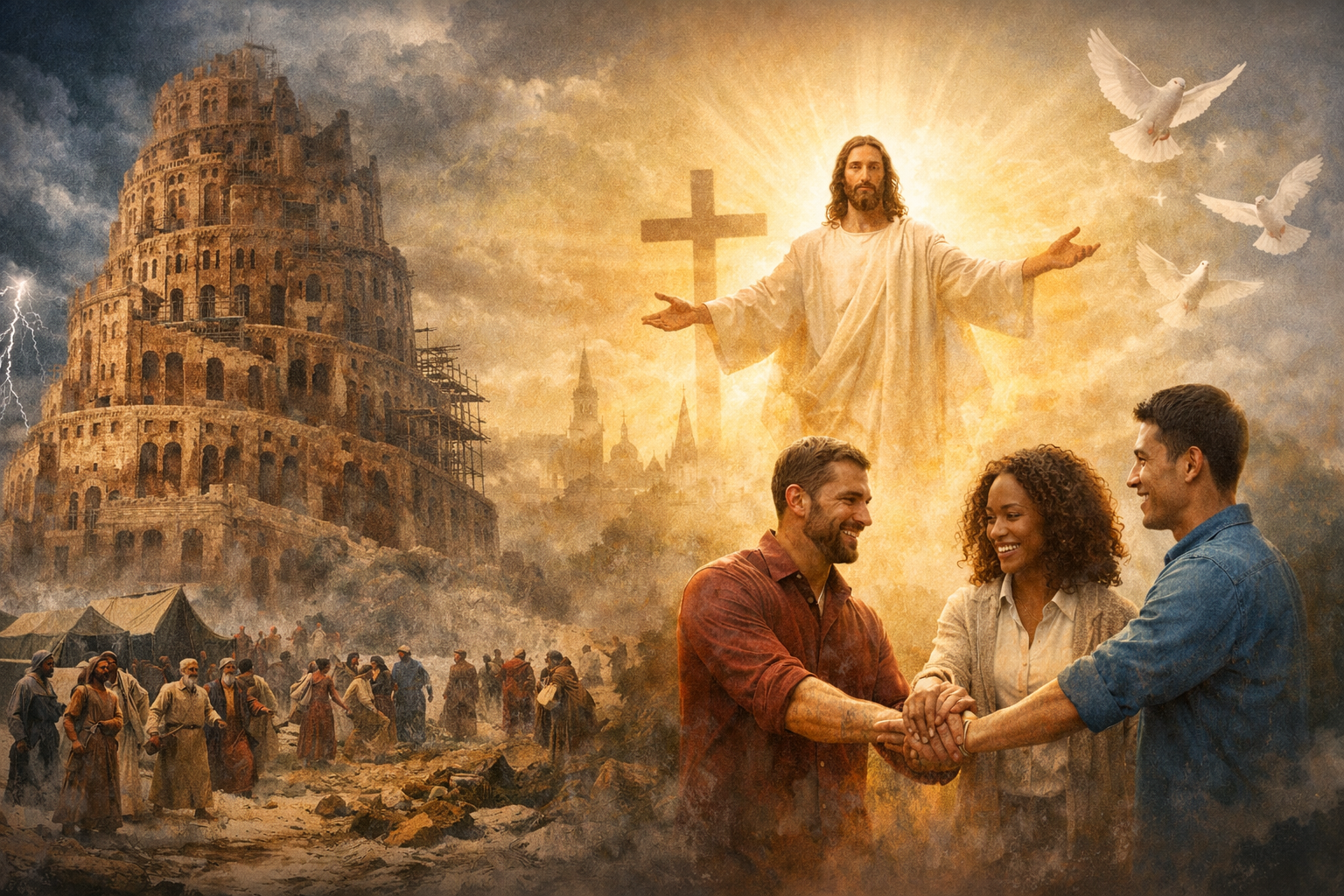
The story of the Tower of Babel is often told as a tale about language, about why humanity suddenly began speaking in many tongues. Whether you take the story as a literal historical event or simply a metaphor is not important. What’s more important is the subtext and meaning of the story itself. Beneath the surface, the story is about something far deeper: division. Babel symbolizes the moment humanity fractured into tribes, separated not only by language but by identity, culture, and belonging. The confusion of tongues is simply the mechanism. The real consequence is separation. The story’s meaning and implications can be appreciated regardless of whether you choose to see it as a literal historical event or not.
In the symbolic language of the story, humanity once stood together, unified. Babel marks the point at which that unity splintered into countless groups, each seeing itself as distinct from the others. Languages multiplied, tribes formed, and with them came the boundaries that have defined human history ever since, nation against nation, race against race, tribe against tribe. Seen this way, the curse of Babel was not merely linguistic confusion. It was the illusion that we are fundamentally separate from one another.
To undo Babel, then, is to undo that illusion. It is to look past the boundaries that appear so real, language, skin color, nationality, culture, and recognize that these are surface-level differences layered atop a deeper unity. Beneath them all, we remain members of the same human family.
This is precisely where the teachings of Jesus enter the story. Again and again, Jesus spoke in ways that dissolved the lines separating people. When he instructed his followers to love their neighbor as themselves, he was not offering a poetic metaphor or a vague moral suggestion. He was pointing toward a radical truth: that every human being is, in fact, our brother or sister. That we are all children of the same Father.
Taken seriously, this teaching reverses the very fragmentation that Babel represents. Where Babel divided humanity into tribes, Jesus calls humanity back into family. Where Babel fostered suspicion of the “other,” Jesus insisted that the other is your neighbor. And where tribal identity encourages us to rank, judge, and exclude, Jesus calls for a recognition of shared belonging.
In this sense, the Tower of Babel story presents the problem, and the teachings of Jesus present the solution. Human misery so often flows from the belief that we are separate, that the people who speak differently, look different, or come from another land are somehow less connected to us. Once we accept that illusion, division becomes easy. Fear becomes easy. Hatred becomes easy. But if we instead recognize that all people share the same origin, the same divine source, those divisions begin to lose their power.
It is easy for superficial differences to deceive us into believing we are separate from one another. Language, culture, politics, race, and identity markers can create the illusion that humanity is divided into competing camps. Yet the spiritual insight at the heart of Jesus’ teaching points in the opposite direction. When he spoke of humanity as the children of one Father and called people brothers and sisters, he was reinforcing a radical idea: beneath the surface distinctions that preoccupy us, we belong to a single human family.
Recognizing this unity, however, requires vigilance against two common traps. The first is the temptation toward superiority—the subtle belief that one’s group, ideology, or identity is somehow more enlightened, moral, or deserving than others. The moment we adopt that posture, we recreate the very divisions we claim to transcend. Instead, the recognition that we are all children of the same source should serve as a quiet reminder within the mind: we are one.
To live according to the teachings of Jesus is therefore not merely to repeat familiar phrases about love and kindness. It requires a genuine shift in perception. It requires seeing through the superficial markers that our societies treat as defining differences and recognizing the deeper unity beneath them. This unity must be affirmed not just intellectually, but spiritually. One must consciously reject the illusion of separation and acknowledge before God, the Father, the Holy Spirit, that humanity is one family. Every person we encounter is another child of the same source. When we do this sincerely, something begins to change. The instinct to judge others as outsiders weakens. The urge to categorize people into tribes begins to dissolve. What replaces it is the recognition that every person we encounter is our neighbor, deserving of dignity, compassion, and blessing. Unfortunately, the opposite message is increasingly common in modern political culture.
In recent years, many political movements, particularly those surrounding Donald Trump, have normalized the idea that it is acceptable, even righteous, to view certain groups of people with hostility simply because they are different. Immigrants, foreigners, and those who do not share the same cultural or national identity are often portrayed as threats rather than neighbors.
Tribalism itself is nothing new. It has existed for centuries. But what is especially troubling today is the attempt to wrap that tribal hostility in the language of Christianity. The teachings of Jesus offer no justification for such attitudes. On the contrary, his message consistently moved in the direction of radical inclusion. He crossed cultural boundaries, embraced outsiders, and insisted that love of neighbor extends beyond the limits of tribe, nation, or identity.
So there is a gravitational pull of cultural tribalism. Modern life constantly invites us to sort ourselves into factions—political parties, sports teams, universities, music scenes, and countless other identity camps. These affiliations can be harmless in themselves, but they easily become vehicles for the deeper instinct toward division. The digital world amplifies this tendency. Online spaces are filled with rhetorical traps designed to provoke outrage and argument. The wiser response is often to refuse the invitation. When anger begins to rise, it can be helpful to pause and recall the deeper principle: the person on the other side of the screen is not an enemy, but another member of the same human family.
Judgment is especially corrosive in this regard. The act of judging others almost automatically constructs a hierarchy in the mind, placing oneself above another. This is one of the reasons forgiveness occupies such a central place in Jesus’ teachings. Forgiveness dissolves the impulse to elevate oneself over others. It interrupts the cycle of comparison and restores the awareness that, beneath our differences and disagreements, we share the same origin and the same essential nature.
To remember this is to resist the illusion of separation and to return, again and again, to the recognition that we are not rivals in a divided world, but participants in a shared humanity.
To present hatred of others or separation from “outsiders” as compatible with Christianity is therefore a profound distortion of the message Jesus taught. This is despite modern right wing and MAGA rhetoric advocating that hatred and separation, while those persons are wearing crosses around their neck or fleshing out their identity with other Christian markers, both offline and online. They are simply incompatible beliefs and you’ll receive nonsensical answers when asking them how their political/social views reconcile with the teachings of Jesus.
The path Jesus outlined leads away from division and toward unity. It asks us to see through the illusions that separate us and recognize that every human being, regardless of language, nation, or appearance, is part of the same family.
In doing so, we begin to reverse the ancient fracture symbolized by Babel. We move, however imperfectly, back toward the unity that humanity once knew and that the teachings of Jesus continually call us to rediscover.



Leave a Reply