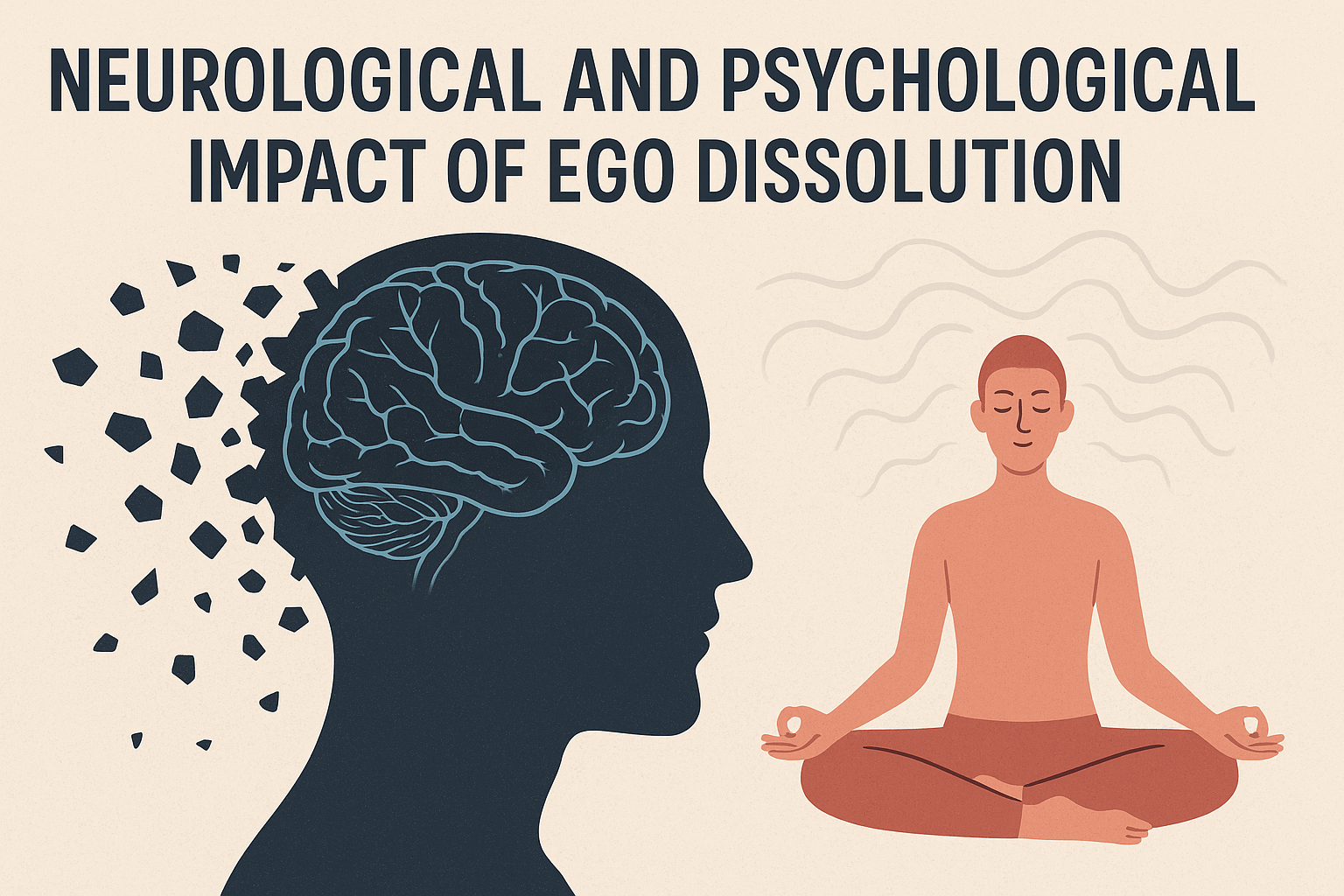
For skeptics and atheists that demand and insist on scientific evidence that supports the claims made by those who have successfully achieved ego transcendence, there have been multiple studies done that confirm and measure the impact of total ego dissolution/transcendence. This can be achieved via two popular methods, first through various traditional spiritual paths/practices also via the use of hard psychedelics, with the former being a safer option to prevent any negative interactions with preexisting medical/neurological conditions. Below you’ll find not only the neurological impact of transcendence of one’s ego, but also the psychological impact as well.
In short, ego dissolution corresponds neurologically to reduced activity in self-referential brain networks (especially the DMN), increased cross-network communication, and altered processing of self vs. world. Psychologically, it can dismantle rigid ego structures, foster a sense of unity, and even promote long-term mental health benefits but it also requires careful integration.
It is a neurological phenomenon where the brain’s usual boundaries that sustain the sense of “I” begin to disintegrate. Under fMRI, regions of the brain such as the default mode network (DMN), which is central to self-referential thinking, show decreased activity and weakened connectivity. This loosening reduces the constant narrative of the ego, creating space for new patterns of perception and integration. Neurotransmitters like serotonin, especially via the 5-HT2A receptor, play a pivotal role in this altered state. As rigid predictive models of the self soften, the brain experiences an increase in global connectivity—regions that rarely communicate start linking, fostering novel associations. Psychologically, this can manifest as feelings of unity, timelessness, and the breakdown of subject-object duality. For many, the experience reduces depression and anxiety by dismantling entrenched patterns of rumination. Ego dissolution can thus be seen not as a loss, but a temporary reset, allowing the nervous system to reorganize, with lasting impacts on creativity, empathy, and well-being.
Core Neurological Mechanisms
Default Mode Network (DMN) Suppression
- The DMN is a network of brain regions (notably the medial prefrontal cortex and posterior cingulate cortex) associated with self-referential thought, autobiographical memory, and the sense of a continuous “I.”
- During ego dissolution (often in meditation, mystical states, or psychedelic experiences), DMN activity decreases, which corresponds with a loosening of the rigid boundary between “self” and “other.”
- This downregulation is one of the most consistent findings in fMRI studies of psilocybin, LSD, and meditation.
2.
Increased Global Connectivity
- Normally, brain networks work in relatively specialized silos (vision, movement, language, etc.).
- During ego dissolution, communication across networks increases, creating a more “integrated” brain state.
- This can produce feelings of unity, interconnectedness, and boundlessness, as sensory, emotional, and cognitive networks share information more freely.
3.
Reduced Predictive Processing
- The brain usually operates by predicting incoming sensory input based on prior experience (a “top-down” model).
- Under ego dissolution, the grip of these predictions weakens, meaning perception becomes more fluid and less constrained by habitual expectations.
- This is why experiences often feel profoundly fresh, novel, or “as if seeing reality for the first time.”
4.
Altered Self–Other Boundaries
- Regions like the insula (interoception) and temporoparietal junction (perspective-taking, self–other distinction) show altered activity.
- This disruption contributes to the sense of merging with others, the universe, or the divine.
Psychological & Emotional Outcomes
- Increased empathy and openness: People often report feeling more compassionate and less rigid in their identities after such experiences.
- Reduced rumination: With the DMN quieted, repetitive self-critical thought patterns lose strength.
- Lasting shifts: Studies show that even after the experience, participants often score higher on measures of well-being, openness, and life satisfaction.
Potential Downsides
- Destabilization: In vulnerable individuals (e.g., with psychosis risk), loss of ego boundaries can be frightening, disorienting, or trigger long-term confusion.
- Integration challenges: Without support, the insights can fade, or the individual may struggle to reconcile the experience with ordinary identity.
The releasing of all fear also dismantles the ego’s defenses, dissolves the illusion of separation, and opens the way to unity with reality as it is.
1. Fear as the Ego’s Foundation
The ego is essentially a survival mechanism: it defines “me vs. not me” and tries to protect that boundary. Fear is the glue that keeps this structure in place:
- Fear of death → the ego clings to self-preservation.
- Fear of rejection → the ego clings to identity, roles, and labels.
- Fear of loss → the ego clings to possessions, relationships, and status.
Without fear, the ego has nothing to defend. It begins to loosen its grip.
2. Fear Creates Separation
Fear always implies division: me vs. danger, me vs. other people, me vs. the unknown. This separation is the essence of the ego.
- To dissolve the ego, one must collapse that sense of division.
- Releasing fear allows you to experience unity — with others, with nature, with God, with the universe.
3. Letting Go = Trust
When you let go of fear, what takes its place is trust:
- Trust in life’s unfolding.
- Trust in your deeper essence beyond personality.
- Trust in the “field” (what some call God, Spirit, or Source).
This surrender is why many mystical traditions describe ego dissolution as a “death” — not of the body, but of fear-based control.
4. Neurological and Psychological Dimension
Research on psychedelics and meditation shows that ego dissolution correlates with reduced activity in the default mode network (DMN) — the brain’s “selfing” center. Fear activates the amygdala and strengthens ego defenses.
- Releasing fear calms these systems, reducing resistance.
- The quieter the fear response, the easier it is to let go of rigid self-boundaries and experience non-duality.
5. Spiritual Perspective
Mystics across traditions echo this:
- Jesus: “Perfect love casts out fear.” (Fear = ego; Love = unity).
- Buddhism: Freedom from fear = Nirvana, release from clinging.
- Sufism: The annihilation of self (fana) requires surrendering all fear of losing the “I.”
Fearlessness is not recklessness — it’s the recognition that nothing essential can be lost.
There’s a growing body of peer-reviewed neuroscience looking directly at the neurological basis of ego dissolution. Here are some of the most cited and relevant studies:
🧠 Key Neuroimaging & EEG Studies
1. Carhart-Harris et al. (2012)
- Neural correlates of the psychedelic state as determined by fMRI studies with psilocybin.
- Findings: Showed reduced blood flow and functional connectivity in the default mode network (DMN), correlating with subjective reports of ego dissolution.
- Journal: Proceedings of the National Academy of Sciences (PNAS).
2. Lebedev et al. (2015)
- Finding the self by losing the self: Neural correlates of ego-dissolution under psilocybin.
- Findings: Ego dissolution was linked to decreased integrity of the DMN and increased global brain connectivity. Stronger ego dissolution predicted higher well-being after the session.
- Journal: Human Brain Mapping.
3. Tagliazucchi et al. (2016)
- Increased global functional connectivity correlates with LSD-induced ego dissolution.
- Findings: LSD significantly increased global connectivity across brain networks, especially between the thalamus, DMN, and salience networks. Connectivity increases were strongly associated with subjective ego dissolution.
- Journal: Current Biology.
4. Nour et al. (2016)
- Ego-dissolution and psychedelics: Validation of the Ego Dissolution Inventory (EDI).
- Findings: Developed and validated a psychometric tool (EDI) to quantify ego dissolution. Linked subjective reports to altered functional brain dynamics under psychedelics.
- Journal: Frontiers in Human Neuroscience.
5. Millière et al. (2018, review)
- Psychedelics, meditation, and selfhood: An integrative framework for the cognitive neuroscience of altered self-consciousness.
- Findings: Reviewed how ego dissolution appears across psychedelics, deep meditation, and other practices. Identified shared mechanisms like reduced predictive processing and DMN suppression.
- Journal: Frontiers in Psychology.
6. Muthukumaraswamy et al. (2013)
- Broadband cortical desynchronization underlies the human psychedelic state.
- Findings: MEG data showed widespread decreases in oscillatory power across the cortex under psilocybin, interpreted as a loosening of the brain’s “control signals,” enabling ego dissolution.
- Journal: Journal of Neuroscience.
7. Preller et al. (2020)
- Changes in global and thalamic brain connectivity in LSD-induced altered states of consciousness are attributable to serotonin 2A receptor stimulation.
- Findings: Confirmed that LSD-induced ego dissolution is mediated via 5-HT2A receptor activation, driving increased thalamocortical connectivity.
- Journal: Current Biology.
Takeaway
Across psilocybin, LSD, and meditation studies, ego dissolution consistently corresponds to:
- Reduced DMN integrity
- Increased global brain connectivity
- Altered self–other boundary processing (insula, temporoparietal junction)
- Serotonin 2A receptor activity driving these network changes
If you enjoy or appreciate what I’m doing on this website, I would appreciate a subscribe! See below. No selling of emails or marketing will occur, it’s just for updates.




Leave a Reply